
We all have a pesky inner critic that tells us that we don’t measure up; we aren’t good enough, not worthy of the love we have in our lives, not beautiful…enough.
How the heck do we deal with this seemingly ever present Beelzebub?
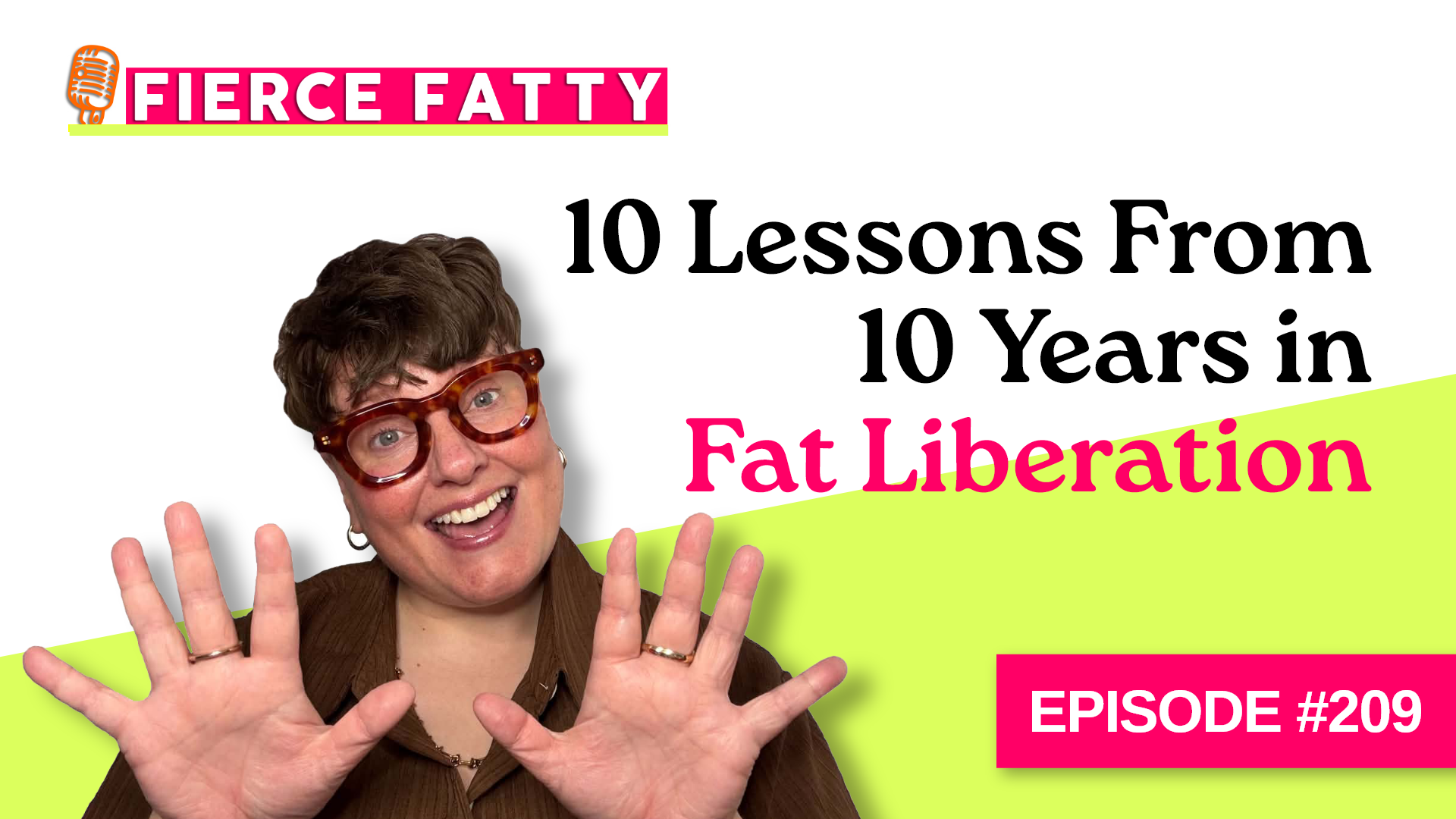
It's been 10+ years since I first discovered fat liberation...here's what I've learned. In 2014, I discovered fat liberation and have been talking about it since. So after all these years, I wanted to share my top takeaways about body image, being fat on the internet, the common fears we share, and more. TW: mention of body image struggles in childhood. Like the podcast? Leave a review where you listen!
People judge others negatively, and that sucks; I’m sorry you have to go through that.
Some people will judge you very harshly and unkindly. Some people will think of you neutrally or positively. Some people are hyper-focused on themselves and whether or not you are judging them negatively.
If you have a bigger body or are marginalized in additional ways, you are going to be experiencing more bias and judgement, and that is not ok.
If someone is judging your body size or fatness negatively, then it might be because they feel shame in their body and want to pass that shame to you to feel temporary relief. It’s not your shame to hold and deal with. Also, some people are just plain cruel or bigoted and you should not have to deal with that.
Those people shouldn’t be able to dictate how we live our lives, what we look like, how we dress or how we present to the world as a fat person. However, they often do get to dictate, either from fear of experiencing shame, changing our behaviours, or due to very real safety concerns, changing our behaviours. This world is often unsafe (especially for the most marginalized), and how you react to that is understandable.
For many of us, the story we've been told about fat bodies seems pretty logical: being fat is unhealthy. We know that society stigmatizes fat people because they “choose to be fat” and “drain public resources.” Others who view body diversity more favourably would argue that it’s not the fault of people in bigger bodies that they are the way they are (because fatness is a “disease”), but it’s still important to be healthy, i.e. in a smaller body. We are taught that concerns about weight are rooted in science, medicine, and a desire to improve individual and population health outcomes.
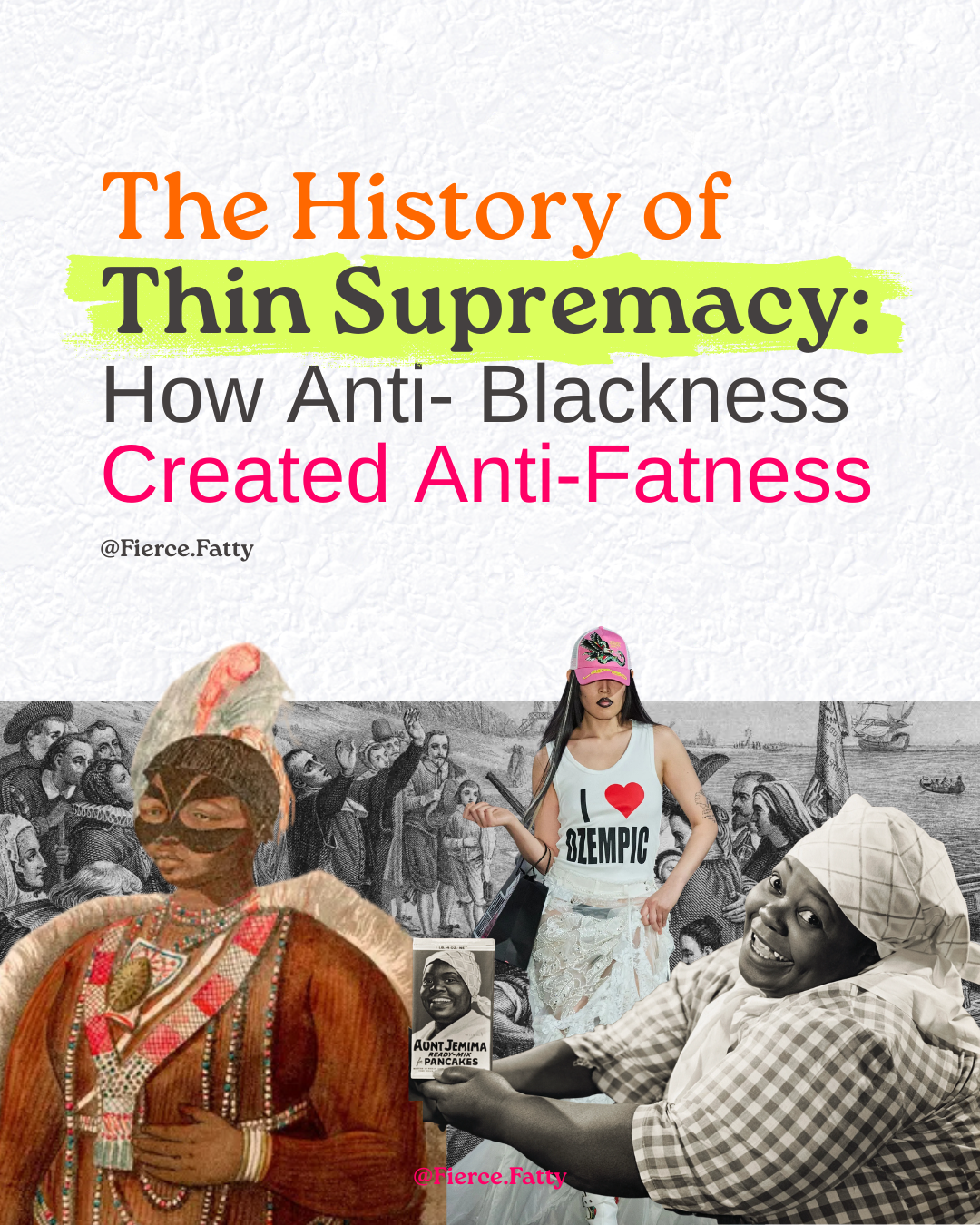
Anti-fatness didn’t begin with medicine. In reality, the beliefs that fat people are unhealthy as well as lazy, unintelligent, undisciplined, unattractive or less worthy have deep roots in religion, the enslavement of Black bodies, colonialism, “scientific” racism, sexism and social control. It was never about health.
Thanks to the work of Black scholars, including Dr. Sabrina Strings, we know that anti-fatness comes from anti-Blackness as well as other oppressive forces. But WHY were certain beliefs about Black bodies created? Who started the myths, and what were they saying? How do those stereotypes about fat Black bodies manifest today? We are going back thousands of years to see where all this nonsense started. Using a variety of sources, including, of course, the go-to book for talking about this Fear of the Black Body by Sabrina Strings, as well as Belly of the Beast by Da’Shaun L. Harrison and concepts from bell hooks, Patricia Hill Collins, and more. TW: O words, anti-Blackness, slavery, sexism, brief mention of sexual assault, general white fuckery.
We’re constantly told that being fat is bad for us, that fat people are ticking time bombs and are pathetic, sad sacks. Is it true? Are fat people giant losers who are doomed to an “unhealthy,” miserable existence? In this episode, we flip the script and explore the surprising advantages of fatness. From better disease outcomes to unique social benefits, mental health perks, and even survival advantages, I share 49 benefits of being fat you probably haven’t considered. How many can you think of? TW: brief mention of O words.
Are you a woman? Do you live in our society? Perhaps you’re a man, or any other gender on the spectrum? Are you a human being alive today? Then listen up here!
You are living in a society that tells you what to find attractive, tells you what beauty is. Right now beautiful is thin, white and young, long legged, eyebrows on fleek, flowing hair, thigh gapped...you get the picture.
If you don’t fall into those categories, tough luck, you ugly girl.
But that’s ok, you can try to get those characteristics, right?
Or can you? And at what cost.
Society has a hella lot of rules for us, especially women. Shame is used to control women and what’s a better way to do it than through policing our bodies. Yay!
If you’re a fatty like me, you can try to blend into the background though and be a “good fatty”.
A good fatty is a fat person who knows that their fatness is a moral failing and is doing everything they can in their power to be thin, showing that they know they are a bad person or make up for their horrendous fatness in another way.
Here is a list of things I used to do when I was a good fatty
I have repeatedly been told that “It will get easier” with looks of sympathy at spin class or to “Keep going, you’ll get there” after a barre session.
I’m fat and that doesn’t mean I haven’t seen the inside of a gym before. It doesn’t mean the only sweating I do is staring through window of a donut store.
This week, I had the honor of being on Good Morning America as a featured panelist for a discussion about diets!
I remember screaming at my desk when I got the email confirming my appearance, and I nearly fainted when I found out I’d be sharing the stage with some of my favorite body positive influencers. I was asked to be on the show as the anti-diet voice in a discussion with Mara Schiavocampo about her best-selling diet book, THINspiration.
As human beings, our bodies are always changing. In fact, we have been constantly changing since the very first day we arrived here on earth. Every part of our body has been evolving over time. It’s a natural part of our human evolution and it’s our body’s way of adapting to our needs, our behaviors and the environment around us.
Imagine if you just decided, against all societal odds and against everything that people say you should feel about your body, that you were comfortable and confident with how you looked and how you ate?
You just decided: I’m confident. I’m okay. I’m doing alright. I should be proud.
Your life would transform in an instant.
The truth is that health is not an obligation, barometer or worthiness, entirely within our control, or guaranteed under any circumstance. The truth is that we should all have the opportunity, but never an obligation, to participate in fitness/athletics/movement at any level we choose. The truth is that we don’t have to make our self-confidence, our self-esteem, or our self-worth contingent on our health, our participation in fitness, or anything else. The truth is that the trolls can (and will) yammer on, but we don’t have to care what they say. The truth I realized for me is that I am the only person who can decide how I feel about myself and my body. The truth is that we are worthy, no matter what.
Aahhh, giving a fuck. It’s a life long battle about what things deserve your fuck giving and what things don’t.
The way I see it, society has asked us women to give a fuck about the wrong things in order to distract us from giving a fuck about the things that really matter. That shit makes me mad girl!
I’m talking about dieting, teaching negative body image, treating women’s bodies as commodities and objects.
For my 18th birthday my dad wrote me a letter. He told me that no matter where I go, what I do or who I become, the most important thing I could ever have is integrity. The strength to stand up for what I believe in, for what's right, even if there are a million other people standing up for what's wrong. Before body positivity, I didn't believe in very much (and I definitely didn't believe in myself), but these days I understand exactly what he meant.
Why are fat bodies hyper-sexualised and slut shamed so often? Is there no other way for a fat women to exist, aside from being the voluptuous siren? With numerous fashion outlets coming up with sporty, alternative fashion for the plus size community, and women showing up for hashtags like Alternative Curves there is a clear message: Like straight sized fashion, we embrace diversity in style and have unique fashion senses.
What does confidence look like through the camera lens?
We know what we’re told confidence it’s ‘supposed’ to look like. We’re told it’s our goal, told what it looks like, what it wears, what it’s proportions are.
Or at least that’s what I thought. That’s what a lot of us think, even as we’re in the process of unlearning the expectations of what our body is ‘supposed to look like’. It felt like one of the remaining big expectations I had put on myself in my own body acceptance journey.
I first heard of Summer after I stumbled onto her podcast Fearless Rebelle Radio and I immediately thought “Who IS this woman? A long lost badass cousin who loves swearing as much as I do!”.
I recently posted an image of myself on Instagram and described myself as fat and beautiful. The first comment I got was from a Nutritional Therapist/Fitness Coach saying “You HAVE fat.... You are not fat. You also have fingernails. You are not fingernails.”
Hmmmm…..
Semantics you may say, she was trying to reassure me that I wasn’t ugly and not to use derogatory names like FAT to describe myself.
Writing this blog post I felt so embarrassed. So ashamed. I also felt scared.
I feel embarrassed because I am a strong confident woman and why would someone like that be with such a loser for 2 years of her life.
I feel ashamed as in some way, it feels like it was my fault, that I deserved it. I worry you will lose respect for me or see me as a victim.
I feel scared because even after 10+ years of being away from him I still suffer from PTSD and worry he will try and hurt me in any way he can.
I have never written about this time in my life because I was scared he would read my words and try to destroy me as punishment for speaking out.