
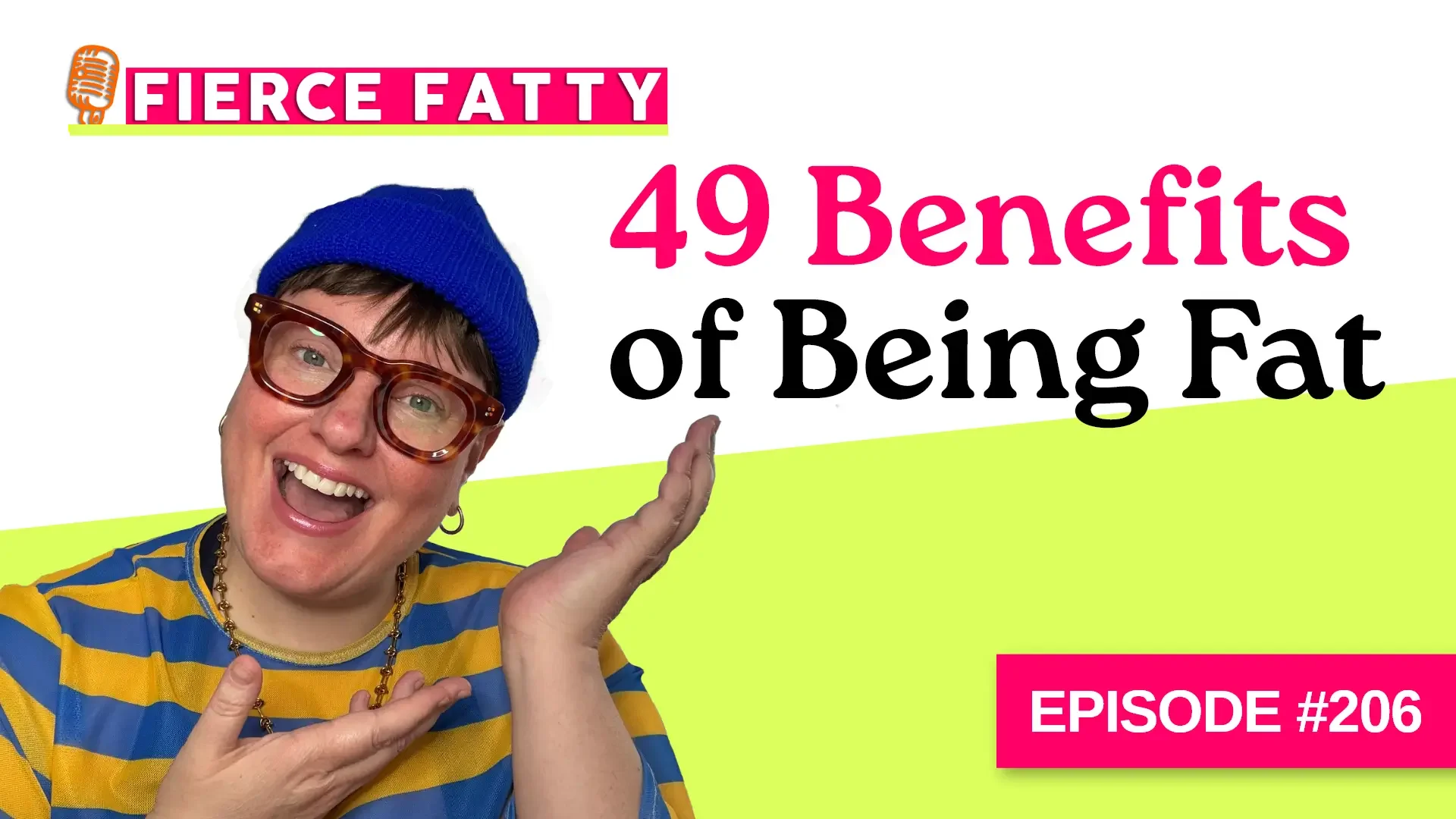
We’re constantly told that being fat is bad for us, that fat people are ticking time bombs and are pathetic, sad sacks. Is it true? Are fat people giant losers who are doomed to an “unhealthy,” miserable existence?
I made a podcast episode listing the 49 benefits in depth, and you can check that out here, but the full list is below! In the episode, we flip the script and explore the surprising advantages of fatness. From better disease outcomes to unique social benefits, mental health perks, and even survival advantages, I share 49 benefits of being fat you probably haven’t considered. How many can you think of? TW: brief mention of O words.
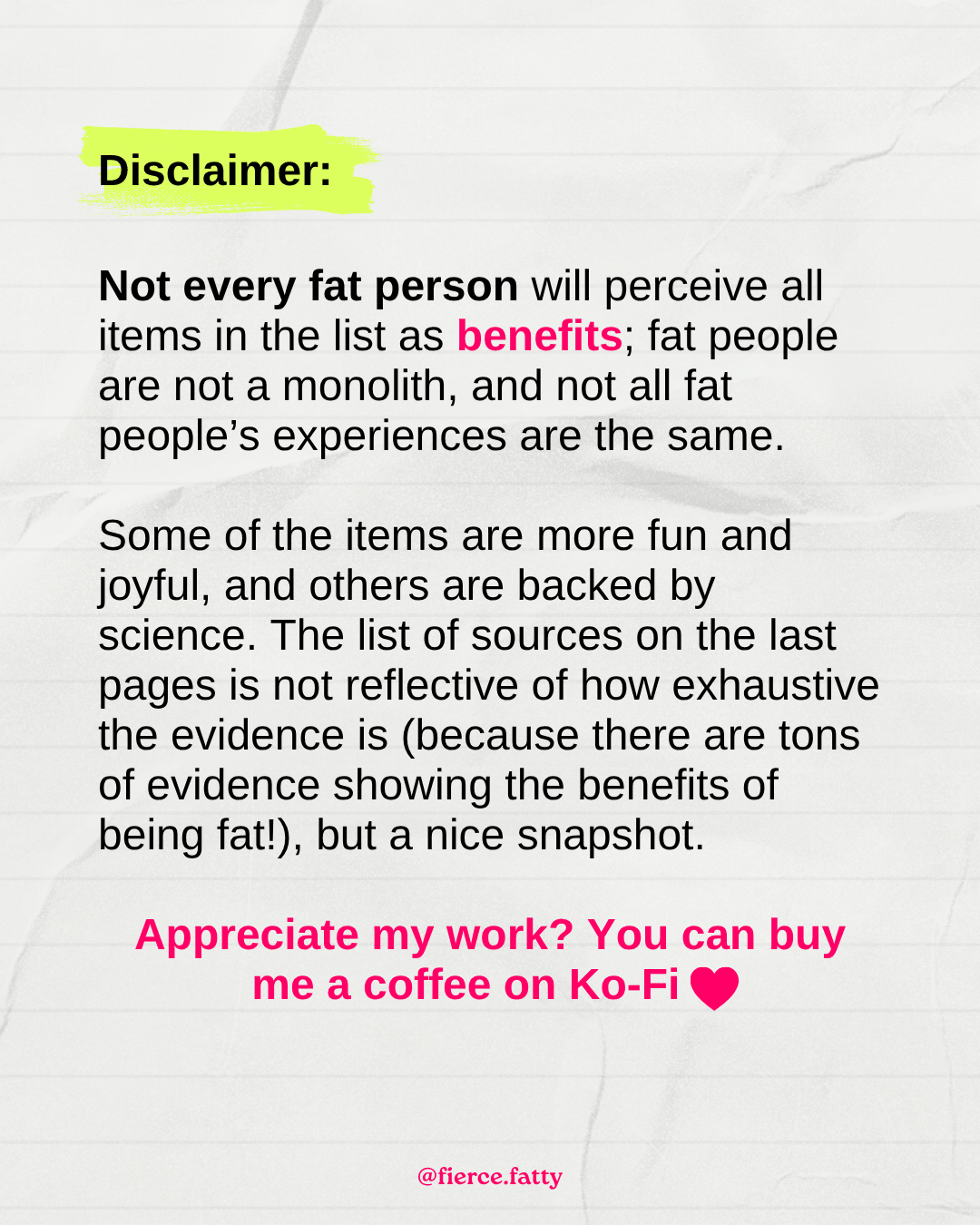
Disclaimer:
Not every fat person will perceive all items in the list as benefits; fat people are not a monolith, and not all fat people’s experiences are the same.
Some of the items are more fun and joyful, and others are backed by science. The list of sources on the last pages is not reflective of how exhaustive the evidence is (because there are tons of evidence showing the benefits of being fat!), but a nice snapshot.
Appreciate my work? You can buy me a coffee on Ko-Fi
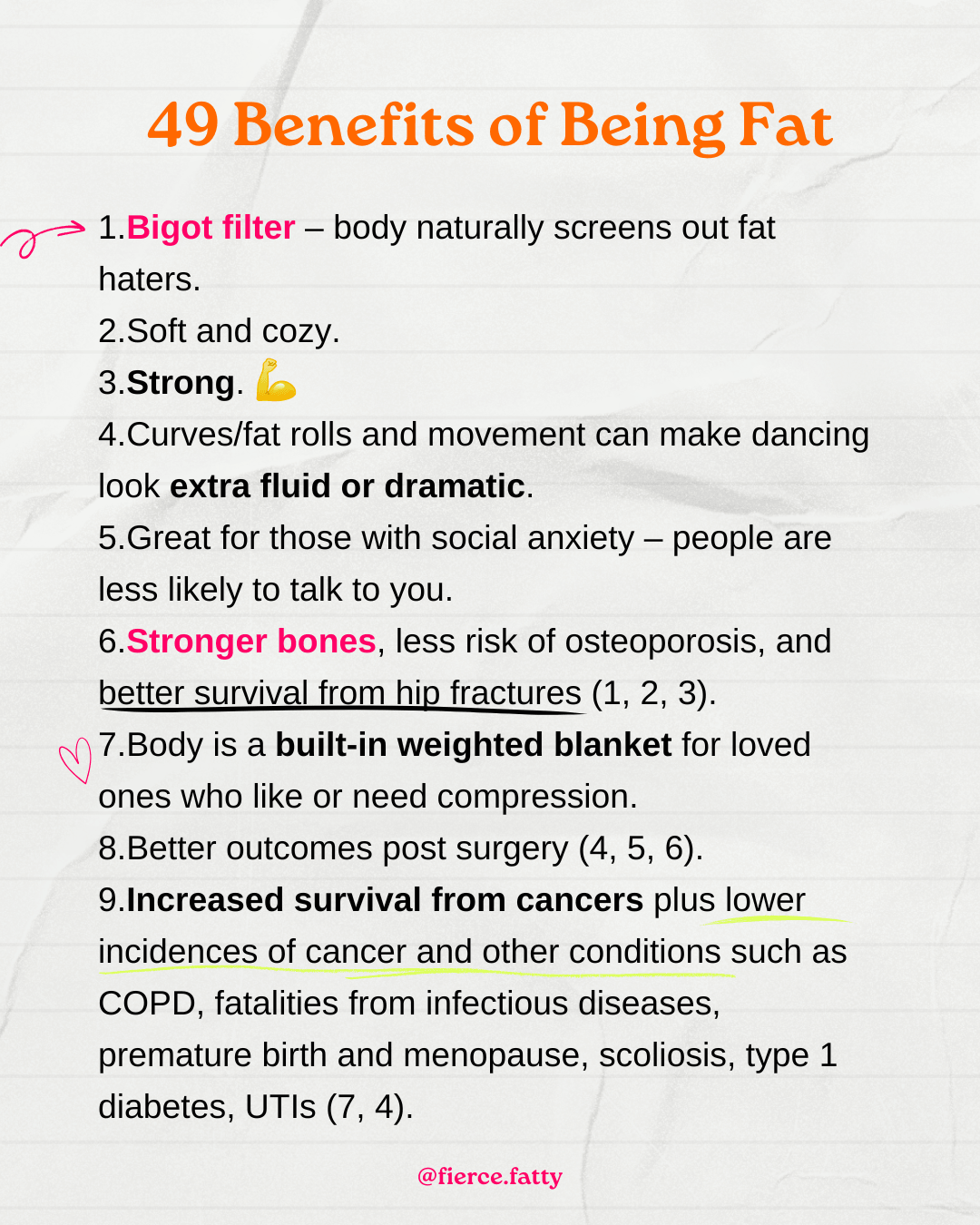
49 Benefits of Being Fat
Soft and cozy.
Strong.
Curves/fat rolls and movement can make dancing look extra fluid or dramatic.
Great for those with social anxiety – people are less likely to talk to you.
Stronger bones, less risk of osteoporosis, and better survival from hip fractures (1, 2, 3).
Body is a built-in weighted blanket for loved ones who like or need compression.
Better outcomes post-surgery (4, 5, 6).
Increased survival from cancers, plus lower incidences of cancer and other conditions such as COPD, fatalities from infectious diseases, premature birth and menopause, scoliosis, type 1 diabetes, and UTIs (7, 4).
Fat pads help our bodies function (8, 9, 10).
Being underestimated and sometimes being able to surprise people.
Easy to find in a crowd.
More tattoo space.
We are the “tank division” in protests: fat people can use their body weight to disrupt, especially helpful if using a mobility scooter.
Fat bodies are better for snow sledding as weight = more speed downhill.
More energy reserves during illness (11).
Built-in community radar – easier to find other fat folks or allies in spaces.
Great counterweight for balancing things like ladders, canoes, or activities like tug of war.
Decreased mortality (12).
Pregnancy and delivery can be easier (13, 14).
Being part of the fat community (15).
Lower death risk after hip fractures (1, 2).
Harder to kidnap.
Environmentally friendly – less bath water needed to fill the tub.
Our bodies are a physical representation of resistance against anti-fat bias and diet culture.
More lap space for pets to curl up.
Great to have sex with (16).
Better survival from certain diseases such as coronary artery disease, pneumonia, chronic kidney disease, colorectal cancer (7, 17, 18, 19).
Increased wind resistance.
Built-in storage – items can rest between stomach and rolls.
Empathy and increased awareness and understanding of bigotry.
Easier to apply testosterone gel.
Adipose tissue is one of the body’s most active and dynamic organs – producing hormones, communicating with organs, regulating temperature and immunity, cushioning organs and joints, and supporting metabolic functions (20, 21, 11, 22).
Safety cushion for organs, joints and bones (23).
Incredible resilience from surviving discrimination.
Mental health – lower rates of suicide (24, 25, 26).
Visually interesting – fat bodies are “made of waves and honey,” and every body is different (27).
Staying fat vs losing weight associated with reduced mortality and cardiovascular disease (28, 29).
More likely to survive disasters (11).
Keeps us warm (20).
Able to hide a pregnancy for longer.
Often memorable to people you meet – physical distinctiveness makes first impressions stick.
Recover more quickly when hospitalized from COVID (30, 31, 32, 33).
Buoyancy.
Momentum advantage in some sports (e.g., roller derby, rugby).
Fat bodies are counterculture and iconic.
Belly shelf for snacks.
Paintball advantage – pellets may bounce without bursting.
Fat joy – living without shame.
References:
Flodin, L., Laurin, A., Lökk, J., Cederholm, T., & Hedström, M. (2016). Increased 1-year survival and discharge to independent living in overweight hip fracture patients. Acta Orthopaedica, 87(2), 146–151. https://doi.org/10.3109/17453674.2015.1125282
Yang, T-I., Chen, Y-H., Chiang, M-H., Kuo, Y-J., & Chen, Y-P. (2022). Inverse relation of body weight with short-term and long-term mortality following hip fracture surgery. Journal of Orthopaedic Surgery and Research, 17, 249. https://doi.org/10.1186/s13018-022-03131-3
Qiao, D., Li, Y., Liu, X., Zhang, X., Qian, X., Zhang, H., Zhang, G., & Wang, C. (2020). Association of obesity with bone mineral density and osteoporosis in adults: A systematic review and meta-analysis. Public Health, 180, 22–28. https://doi.org/10.1016/j.puhe.2019.11.001
Valentijn, T. M., Galal, W., Hoeks, S. E., van Gestel, Y. R., Verhagen, H. J., & Stolker, R. J. (2013). Impact of obesity on postoperative and long-term outcomes in a general surgery population: A retrospective cohort study. World Journal of Surgery, 37(11), 2561–2568. https://doi.org/10.1007/s00268-013-2162-y
Mullen, J. T., Moorman, D. W., & Davenport, D. L. (2009). The obesity paradox: Body mass index and outcomes in patients undergoing nonbariatric general surgery. Annals of Surgery, 250(1), 166–172. https://doi.org/10.1097/SLA.0b013e3181ad8935
Wang, Q., Li, Z., Wang, X. H., Li, B., Wang, C., & Xiang, Y. (2025). Effect of obesity on perioperative outcomes following lung cancer surgery: A systematic review and meta-analysis. Frontiers in Oncology, 15, 1600503. https://doi.org/10.3389/fonc.2025.1600503
Ernsberger, P., & Haskew, P. (1987). Rethinking Obesity: An Alternative View of Its Health Implications. Human Sciences Press.
Pinto, V., Pignatti, M., Parente, G., Di Salvo, N., Contu, L., & Lima, M. (2023). Role of autologous fat grafting in the conservative treatment of fecal incontinence in children. Journal of Clinical Medicine, 12(4), 1258. https://doi.org/10.3390/jcm12041258
Macchi, V., Stocco, E., Stecco, C., Belluzzi, E., Favero, M., Porzionato, A., & De Caro, R. (2018). The infrapatellar fat pad and the synovial membrane: An anatomo-functional unit. Journal of Anatomy, 233(2), 146–154. https://doi.org/10.1111/joa.12820
Grigoriadis, G., Newell, N., Carpanen, D., Christou, A., Bull, A. M. J., & Masouros, S. D. (2017). Material properties of the heel fat pad across strain rates. Journal of the Mechanical Behavior of Biomedical Materials, 65, 398–407. https://doi.org/10.1016/j.jmbbm.2016.09.003
Norgan, N. G. (1997). The beneficial effects of body fat and adipose tissue in humans. International Journal of Obesity, 21(9), 738–746. https://doi.org/10.1038/sj.ijo.0800473
Flegal, K. M., Kit, B. K., Orpana, H., & Graubard, B. I. (2013). Association of all-cause mortality with overweight and obesity using standard body mass index categories: A systematic review and meta-analysis. JAMA, 309(1), 71–82. https://doi.org/10.1001/jama.2012.113905
Durnea, C. M., Jaffery, A. E., Gauthaman, N., & Doumouchtsis, S. K. (2018). Effect of body mass index on the incidence of perineal trauma. International Journal of Gynecology & Obstetrics, 141(2), 166–170. https://doi.org/10.1002/ijgo.12403
Garretto, D., Lin, B. B., Syn, H. L., Judge, N., Beckerman, K., Atallah, F., Friedman, A., Brodman, M., & Bernstein, P. S. (2016). Obesity may be protective against severe perineal lacerations. Journal of Obesity, 2016, 9376592. https://doi.org/10.1155/2016/9376592
Meadows, A., & Higgs, S. (2022). Challenging oppression: A social identity model of stigma resistance in higher-weight individuals. Body Image, 42, 237–245. https://doi.org/10.1016/j.bodyim.2022.06.004
Tonic, G. (2021, February 12). Why I only want to have sex with fat bodies. Cosmopolitan. https://www.cosmopolitan.com/uk/love-sex/sex/a32823682/fat-sex/
Niedziela, J., Hudzik, B., Niedziela, N., et al. (2014). The obesity paradox in acute coronary syndrome: A meta-analysis. European Journal of Epidemiology, 29, 801–812. https://doi.org/10.1007/s10654-014-9961-9
Li, Y., Li, C., Wu, G., Yang, W., Wang, X., Duan, L., Niu, L., Chen, J., Zhang, Y., Zhou, W., Liu, J., Hong, L., & Fan, D. (2022). The obesity paradox in patients with colorectal cancer: A systematic review and meta-analysis. Nutrition Reviews, 80(7), 1755–1768. https://doi.org/10.1093/nutrit/nuac005
Nie, W., Zhang, Y., Jee, S. H., Jung, K. J., Li, B., & Xiu, Q. (2014). Obesity survival paradox in pneumonia: A meta-analysis. BMC Medicine, 12, 61. https://doi.org/10.1186/1741-7015-12-61
Brookshire, B. (2026). Fat doesn’t deserve its bad rap. Scientific American. Retrieved March 9, 2026, from https://www.scientificamerican.com/article/fat-doesnt-deserve-its-bad-rap/
Gunawardana, S. C. (2014). Benefits of healthy adipose tissue in the treatment of diabetes. World Journal of Diabetes, 5(4), 420–430. https://doi.org/10.4239/wjd.v5.i4.420
Sakers, A., De Siqueira, M. K., Seale, P., & Villanueva, C. J. (2022). Adipose-tissue plasticity in health and disease. Cell, 185(3), 419–446. https://doi.org/10.1016/j.cell.2021.12.016
Chuang, J.-F., Rau, C.-S., Liu, H.-T., Wu, S.-C., Chen, Y.-C., Hsu, S.-Y., Hsieh, H.-Y., & Hsieh, C.-H. (2016). Obese patients who fall have less injury severity but a longer hospital stay than normal-weight patients. World Journal of Emergency Surgery, 11, 3. https://doi.org/10.1186/s13017-015-0059-9
Perera, S., Eisen, R. B., Dennis, B. B., Bawor, M., Bhatt, M., Bhatnagar, N., Thabane, L., de Souza, R., & Samaan, Z. (2016). Body mass index is an important predictor for suicide: Results from a systematic review and meta-analysis. Suicide and Life-Threatening Behavior, 46(6), 697–736. https://doi.org/10.1111/sltb.12244
Lee, J., Lee, S.-H., Kim, M.-K., Kwon, H.-S., Yun, J.-S., Yang, Y., Yoon, K.-H., Cho, J.-H., Pae, C.-U., Han, K., & Son, J. W. (2025). Inverse association between obesity and suicidal death risk. BMC Psychiatry, 25, 27. https://doi.org/10.1186/s12888-024-06381-z
Geulayov, G., Ferrey, A., Hawton, K., Hermon, C., Reeves, G. K., Green, J., Beral, V., Floud, S., & Million Women Study Collaborators. (2019). Body mass index in midlife and risk of attempted suicide and suicide: Prospective study of 1 million UK women. Psychological Medicine, 49(13), 2279–2286. https://doi.org/10.1017/S0033291718003239
Allen, E. (Poem quote). “Kiss your own fingertips and hug your own curves…” Retrieved from https://www.goodreads.com/quotes/7530470-kiss-your-own-fingertips-and-hug-your-own-curves-you
Alharbi, T. A., Paudel, S., Gasevic, D., Ryan, J., Freak-Poli, R., & Owen, A. J. (2021). The association of weight change and all-cause mortality in older adults: A systematic review and meta-analysis. Age and Ageing, 50(3), 697–704. https://doi.org/10.1093/ageing/afaa231
Zou, H., Yin, P., Liu, L., Liu, W., Zhang, Z., Yang, Y., Li, W., Zong, Q., & Yu, X. (2019). Body-weight fluctuation was associated with increased risk for cardiovascular disease, all-cause and cardiovascular mortality: A systematic review and meta-analysis. Frontiers in Endocrinology, 10, 728. https://doi.org/10.3389/fendo.2019.00728
Subramaniam, A., Ling, R. R., Ridley, E. J., & Pilcher, D. V. (2023). The impact of body mass index on long-term survival after ICU admission due to COVID-19: A retrospective multicentre study. Critical Care and Resuscitation, 25(4), 182–192. https://doi.org/10.1016/j.ccrj.2023.10.004
Deng, L., Zhang, J., Wang, M., & Chen, L. (2021). Obesity is associated with severe COVID-19 but not death: A dose-response meta-analysis. Epidemiology & Infection, 149, e144. https://doi.org/10.1017/S0950268820003179
Ioannou, G. N., Locke, E., Green, P., Berry, K., O’Hare, A. M., Shah, J. A., Crothers, K., Eastment, M. C., Dominitz, J. A., & Fan, V. S. (2020). Risk factors for hospitalization, mechanical ventilation, or death among 10,131 US veterans with SARS-CoV-2 infection. JAMA Network Open, 3(9), e2022310. https://doi.org/10.1001/jamanetworkopen.2020.22310
Chastain, R. (2020, October 5). Study – Body Size NOT a COVID-19 Risk Factor. Dances With Fat. https://danceswithfat.org/2020/10/05/study-body-size-not-a-covid-19-risk-factor/
Here’s the above text as images…
About the Author:

Vinny Welsby (they/them) is a fat activist, diversity, equity and inclusion leader and founder of Fierce Fatty and Weight Inclusive Consulting. They have been a leading voice in dismantling anti-fat bias and diet culture for over a decade, a TEDx speaker, a podcast host, and a master's student in psychotherapy. Vinny is trans-non-binary and is dedicated to shifting how society views fat and queer bodies through education and compassion.
When Vinny isn’t talking about DEI stuff, they love snuggling with their dog, cross-stitching swear words and singing in a pop choir.
Follow Vinny on Instagram, Facebook or LinkedIn or get their free resources the Body Love Roadmap or How to Make Your Workplace Size Inclusive (or check out many other free resources here).