
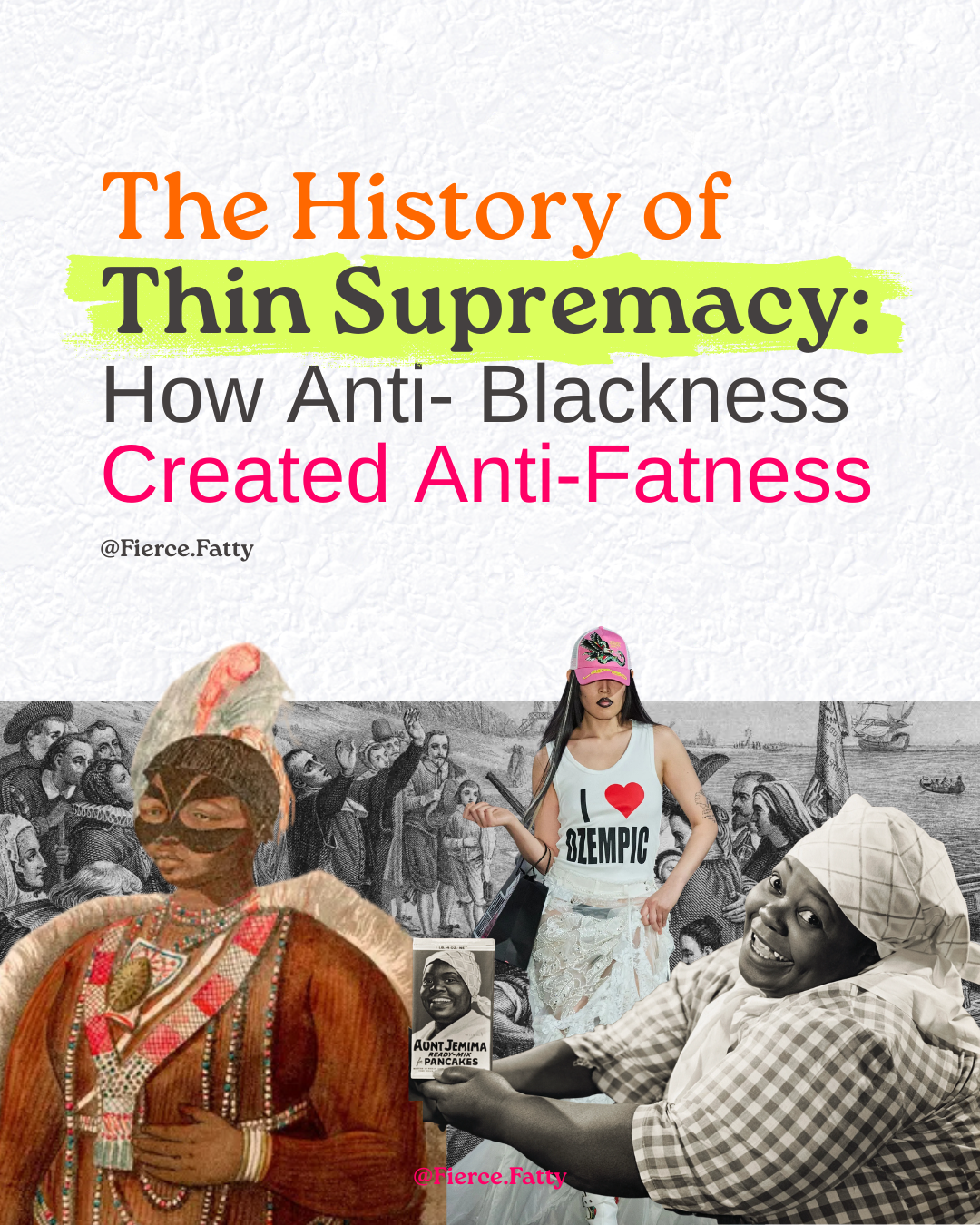
For many of us, the story we've been told about fat bodies seems pretty logical: being fat is unhealthy. We know that society stigmatizes fat people because they “choose to be fat” and “drain public resources.” Others who view body diversity more favourably would argue that it’s not the fault of people in bigger bodies that they are the way they are (because fatness is a “disease”), but it’s still important to be healthy, i.e. in a smaller body. We are taught that concerns about weight are rooted in science, medicine, and a desire to improve individual and population health outcomes.
Anti-fatness didn’t begin with medicine.
In reality, the beliefs that fat people are unhealthy as well as lazy, unintelligent, undisciplined, unattractive or less worthy have deep roots in religion, the enslavement of Black bodies, colonialism, “scientific” racism, sexism and social control. It was never about health.
The following timeline follows the evolution of those beliefs from ancient times to the present day. A full list of sources can be found at the bottom of this blog, but essential reading comes from Belly of the Beast by Da’Shaun L. Harrison (they/them) and Fearing the Black Body by Sabrina Strings (she/her).
Want to dive deeper into this topic? Listen to episode 207 of the Fierce Fatty Podcast - The History of Thin Supremacy: How Anti-Blackness Created Anti-Fatness.
FYI: The timeline is imperfect and incomplete, but it provides some important key information.
The History of Anti-Fatness (and Anti-Blackness)
c. 500 BCE - Ancient Greek & Roman Virtue Traditions
Philosophers such as Plato and Aristotle emphasized moderation as a virtue, promoting moderation and self-control; eating lots of food was criticized, but fatness itself was not a major social concern. These ideas later influenced Christian teachings, where self-denial and restraint became moral ideals that shaped Western attitudes toward eating and the body

Plato and Aristotle depicted in a painting by artist Raphael called The School of Athens (1511).
c. 30 CE - Early Christianity
Many early Christians viewed the body as something that required discipline. Spiritual growth was associated with self-control over bodily desires, including food, sex, and pleasure. Fasting and self-denial became signs of holiness, reinforcing the idea that controlling the body reflected moral virtue. This shifted the focus from moderation as a virtue (in Greek philosophy) to self-denial as a spiritual ideal.
c. 500 – 1500- Medieval Christianity
Gluttony became one of the Seven Deadly Sins. It included eating too eagerly, too soon, wanting food prepared in particular ways, or eating "too much." A person's appetite became a moral issue. Bodily discipline was viewed as evidence of spiritual discipline.

Gluttony depicted by artist Hieronymus Bosch (c. 1500). In it, a fat man eats at a messy table, in a dishevelled room, while ignoring his fat child.
c. 1400 – 1600 - Renaissance Body Ideals
Slightly soft bodies (not actually fat - more like mid-size in today’s standards) were often associated with beauty, fertility, prosperity, and health. Today, this point in history is highlighted as evidence that fat bodies used to be celebrated in the global north, but actual fat people were not depicted in these paintings; instead, softer, straight-sized bodies were.

The Birth of Venus by Sandro Botticelli (c. 1486), considered a Renaissance masterpiece and one of the most recognizable Renaissance paintings.
c. 1517 – 1650s - Protestant Reformation
Protestant Puritan culture valued restraint, discipline, hard work, and self-control; they claimed food “corrupted the soul and dimmed intellect.” Activities associated with bodily pleasure become morally suspect, including sex, food and laziness. Fatness, therefore, symbolizes a body that is perceived as indulging in physical appetites. The Puritans colonized Turtle Island (aka the Americas) and brought their logic: Laziness + gluttony → Lack of self-control → poor character → moral weakness + perverted soul = reduced social worth.
Want to dive deeper into this religious aspect? Then listen to episode 152 of the Fierce Fatty Podcast - Diet Culture and Religion.
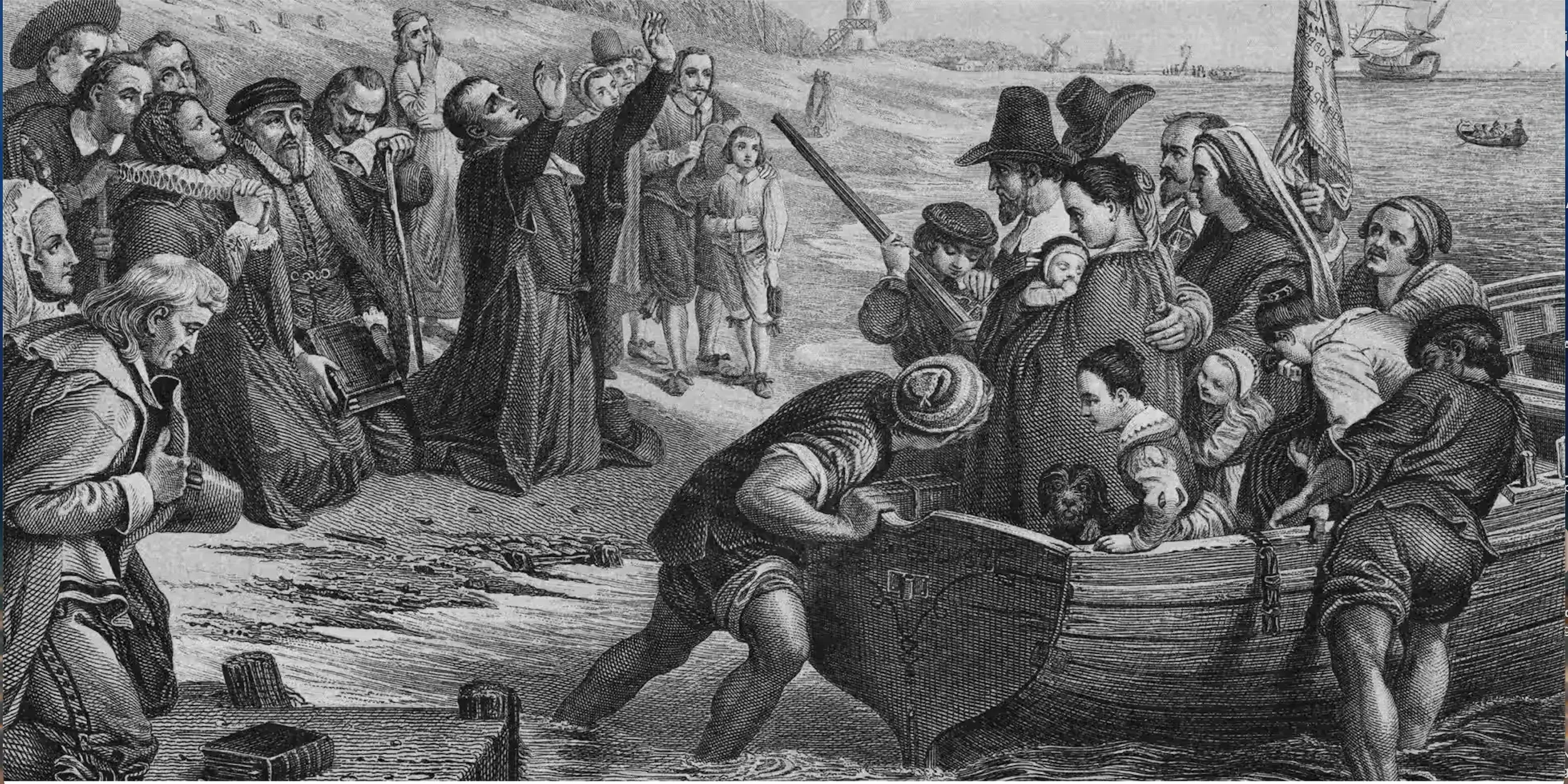
English separatist Puritans leaving the Netherlands to colonize Turtle Island in 1620 by C.W. Cope (1856).
c. 1600 – 1700 - Rise of Anti-Fat Sentiment Among White Men
English and European men, such as William Shakespeare and René Descartes, increasingly portrayed fatness in other men as evidence of laziness, poor judgment, and lack of reason. The idea was that a full stomach was equal to an empty head, and that indulging the body ruined the intellect. “Walter Charleton, a natural philosopher and court physician to Charles I, published his own treatise on the perils of overindulgence. The ‘finest wits,’ Charleton wrote, were not ‘the custody of gross and robust bodies; but for the most part [are lodged] in delicate and tender constitutions.’” - Dr. Sabrina Strings

Sir John Falstaff (painted by Adolf Schrödter) is a fictional character created by Shakespeare who links his fat body to gluttony, indulgence, laziness, and lack of self-control, calling him "fat-witted" and a "fat rogue."
c. 1480s - Transatlantic Enslavement Began
The enslavement of Black Africans was justified through a variety of reasons: economic interests, religion, conquest and ideas about making non-Christians “civilized.” But as the enslavement of Black bodies expanded, becoming super profitable, a better “ justification” for the practice would soon be needed.
c. 1500s + 1600s - Colonial Expansion & Large Scale Transatlantic Enslavement
White men wrote accounts of Black people, often enslaved. In the 1580s, Prospero Alpini, an Italian physician and botanist, wrote about Egyptians, “Can one desire anything more shameful than an ob*sity acquired through the infamous vice of the flesh and of unchecked sensuality? . . . This vice is so widespread down there that one sees most women flopped down on the ground like fat sows.”
Samuel Purchas, an English clergyman who only read secondhand reports of Black people from other white men, claimed “They have no knowledge of God. . . . They are very greedie eaters, and no lesse drinkers, and very lecherous, and theevish, and much addicted to uncleanenesse: one man hath as many wives as hee is able to keepe and maintaine.”

Prospero Alpini, racist.
c. 1680s – 1790s - Enlightenment Era & Early Race “Science”
White people began incorrectly classifying humans into races and associating whiteness with reason and restraint while depicting Black people as fat, greedy, lazy, stupid, animalistic and driven by lust. Jean-Baptiste-Pierre Le Romain, a French colonizer in the Caribbean, said Black enslaved people were "generally lazy, cowardly, and very fond of gluttony".

The Encyclopédie or Encyclopedia, or a Systematic Dictionary of the Sciences, Arts and Crafts. Jean-Baptiste-Pierre Le Romain contributed racist to entries about the Caribbean.
c. 1704 - First “Slave” Patrols
Designed to catch, terrorize, and violently punish enslaved people, these patrols formed the foundation of modern American policing, permanently positioning the Black body as criminal, outlawed, and a perpetual fugitive. Black bodies continue to be surveilled, monitored and regulated today, especially through medicine and public health.

Woodcut from 1839 Anti-Slavery Almanac, showing an enslaved person being captured by a “slave” patrol.

George Cheyne, his own diet book didn’t work for him
C. 1740s: First Diet Book
George Cheyne, a fat physician, promoted a restrictive vegetarian diet as morally and physically superior. Not at all surprising, George lost weight only temporarily on his diet and then regained it, but still had the audacity to write one of the 1st diet books titled “The Natural Method of Curing the Diseases of the Body.” The 5th edition of which was just printed in 2012.
c. 1750 onwards - Scientific Racism
“Scientists” needed to come up with evidence to further justify the enslavement of millions and used body size and other physical traits to create racial hierarchies. Edward Long, a British colonizer who managed and profited from plantations, claimed Black people had no taste for anything but "gourmandizing (the act of enjoying fine food and drink - often in lavish quantities) and drinking to excess, and no moral sensations," and a desire to be idle.
Samuel Cartwright, the physician who created a condition called “drapetomania,” which was the pseudoscientific "mental illness" which claimed that if enslaved people escaped, they must have this mental illness, also invented another disease called "dysaesthesia aethiopica." He claimed this disease was a weakness or lack of work ethic that supposedly afflicted Black people if they were not enslaved and strictly managed, making enslavement a necessary medical "treatment."
The logic claimed that Black people were naturally lazy, they are naturally fat, and the only way to “help” them is to enslave them.

The anti-slavery record, 1837, showing an image of a freedom seeker that would be used in newspaper runaway “slave” ads.
c. 1810 - The "Hottentot Venus"
Born in what is now South Africa, Saartjie (pronounced Sarky, also known as Sara) Baartman, a Khoi Khoi woman, was taken to Europe and exhibited as a “freak show”, framed as a grotesque, hypersexual spectacle. Audiences were encouraged to stare at her body, particularly her buttocks, which were treated as evidence of Black women being more sexual, more primitive, and more excessive. Her body was a site onto which racist fantasies and fears were projected. Saartjie died in 1815, and the exploitation continued; her skeleton, brain, and preserved genitalia remained on display in a French museum until 1974 and were only repatriated in 2002. The word “Hottentot” is now rightfully seen as a racial slur. It was imposed by white colonizers, who mockingly claimed it mimicked the sound of Khoisan languages.

Etching of Baartman by F.C. Lewis used to advertise the exhibit of Saartjie for a fee of two shillings in 1810, in London, UK.
c. 1810s - The Mammy Caricature
The image of the "Mammy" emerged where enslaved fat Black women were depicted as asexual (or without the ability to be seen as sexual), unkempt, subservient caregivers, the only “acceptable” fat Black body. Think Aunt Jemima, the pancake mix brand that used the mammy trope in advertising. Other caricatures framed Black women as sexually aggressive, masculine and animalistic.
“It is not too difficult to imagine how whites came to create the black mammy figure. Considering white male lust for the bodies of black females, it is likely that white women were not pleased with young black women working in their homes for fear that liaisons between them and their husbands might be formed, so they conjured up an image of the ideal black nanny. She was first and foremost asexual, and consequently, she had to be fat (preferably obese); she also had to give the impression of not being clean, so she was the wearer of a greasy, dirty headrag; her too-tight shoes, from which emerged her large feet, were further confirmation of her bestial cow-like quality. Her greatest virtue was, of course, her love for white folk whom she willingly and passively served. The mammy image was portrayed with affection by whites because it epitomized the ultimate sexist-racist vision of ideal black womanhood—complete submission to the will of whites. In a sense, whites created in the mammy figure a black woman who embodied solely those characteristics they as colonizers wished to exploit.” - Da'Shaun L. Harrison, Belly of the Beast

Promo image of Anna Robinson for Aunt Jemima pancake mix, 1933. The mammy trope propagates the idea of a fat, submissive, non-sexual Black woman happy to serve white families.
c. 1810s - Good Anglo-Saxon White Women
For white women, being an Anglo-Saxon Protestant meant acting as "God's appointed agent of morality", with many believing that being Anglo-Saxon was the highest stage of human development (these ideas were a part of eugenics). Popular publications like Godey's Lady's Book and Harper's Bazar implored women to keep a slim and feminine figure and not eat too much so as not to be like fat Black women “on the continent.” White women embraced strict diets to visually and morally distinguish themselves from Black people and new waves of immigrants, such as the Irish or Eastern Europeans who were not yet seen as “fully white.”
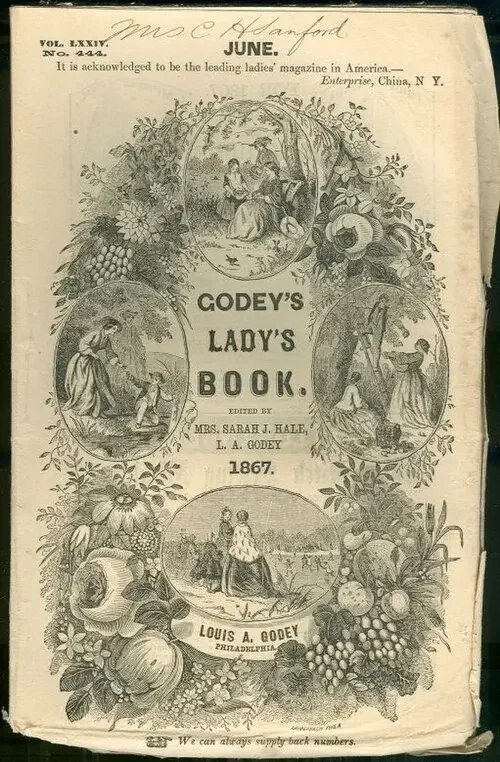
Godey's Lady's Book cover from June 1867 issue.
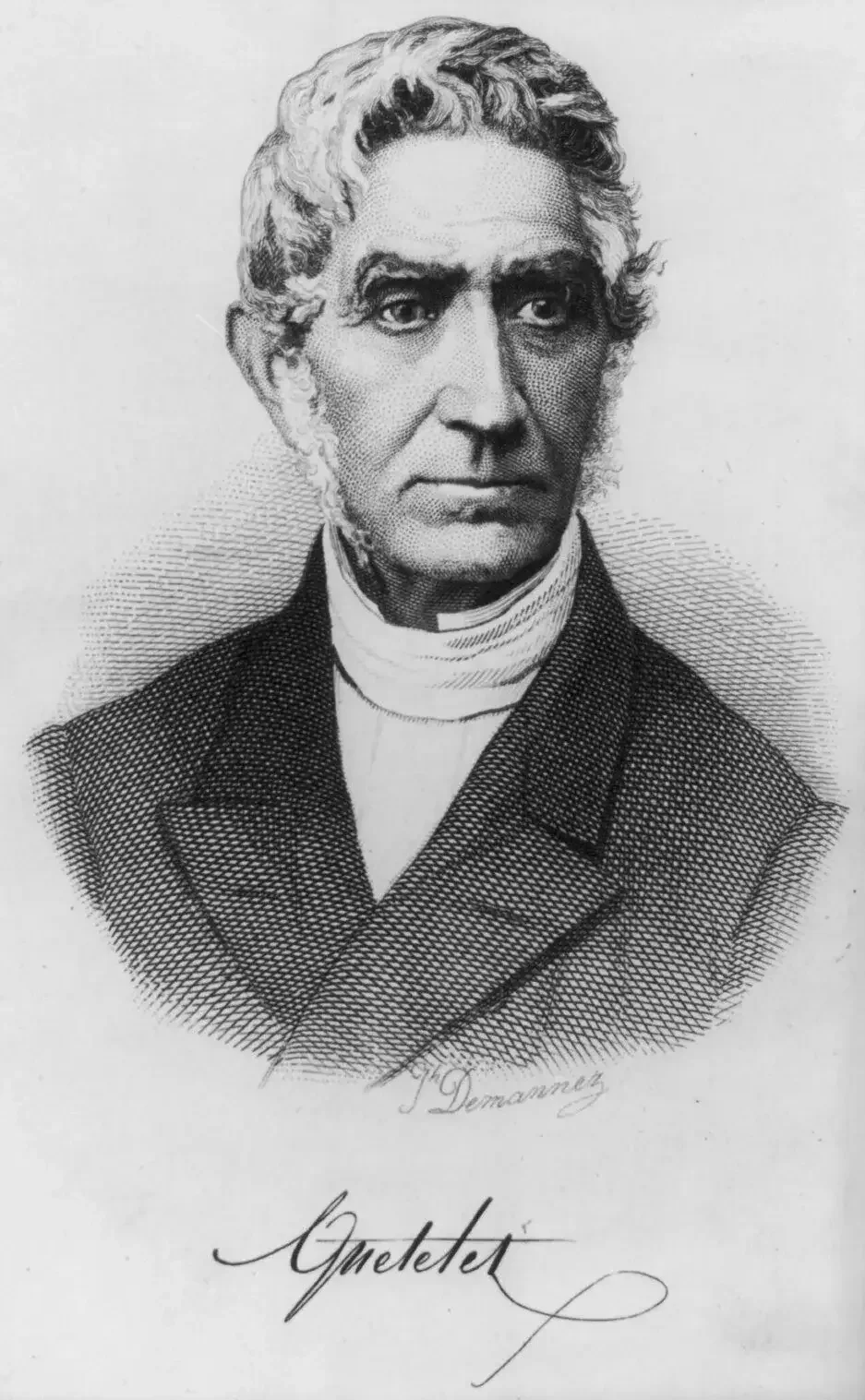
Adolphe Quetelet
c. 1830s – 1900 - Statistics, Measurement & "Normal" Bodies
Population measurement, averages, and body classification systems emerged, laying the groundwork for weight norms. In 1830, Adolphe Quetelet (pronounced kettle-ay) created the Quetelet formula, based on data from young white European men, which later became BMI; it reflected eugenic ideals, wasn’t designed for health, but was misused to label fatness as abnormal and unhealthy. Fatness now not only equals immoral, ugly, lazy, but also unhealthy.
c. 1880s – 1945 - Eugenics Movement
Body size, fitness, reproduction, and racial "improvement" became major concerns of governments and scientists. Fat bodies were framed as signs of biological inferiority, moral weakness, and a threat to the health of nations. American eugenicist Charles Davenport claimed that fatness was a “hereditary defect” and people with "undesirable" traits (including fatness and others) should be discouraged or prevented from reproducing.
c. 1890s – 1960s - Modern Beauty & Diet Culture
Thinness became increasingly associated with attractiveness, especially for women, fueled by magazines, fashion, and consumer culture. The roots (anti-Blackness) of the desire for thinness are fading from popular memory.

1908 newspaper advert promoting the “Kresslin Treatment,” from Dr. Bromley, which claims to permanently make people thin with “free trial treatments for a limited period” sent to homes.
c. 1940s – 1980s - Insurance Medicine & Weight Standards
Insurance companies and public health institutions established weight categories and risk tables based on population-size averages of those who paid for insurance, not actual health. In the 1940s, Louis Dublin, the MetLife insurance company chief statistician, looked at the average weight of their policyholders, who were mostly affluent white men and set arbitrary weight limits, charging people who were a higher weight than average more for their insurance. This policy was based on increasing profit, not health. That policy then shaped U.S. health policy and inflated risk categories; later, lobbying from the diet industry lowered BMI cutoffs, fueling the “ob*sity epidemic” rhetoric.

Louis Dublin, Chief Statistician, the Metropolitan Life Insurance Company.
c. 1960s – Present - Commercial Diet Industry
Jean Nidetch founded the first major diet company, Weight Watchers, in 1963, despite long-standing evidence at the time that diets fail. Weight Watchers leaders openly stigmatized fat people, including saying they were excellent customers as they keep coming back when their product (WW diet) fails. The company’s own data shows almost no long-term weight-loss success. Companies like Weight Watchers popularized lifelong weight-loss programs and normalized dieting as a form of self-improvement.

Jean Nidetch founder of Weight Watchers, speaking and celebrating the release of her book.
c. 1974 onwards - The Welfare Mother/Queen Caricature
This stereotype emerged to portray Black women as content to sit around, collect state funds, and pass on bad values to their children, i.e., lazy, fat and stupid. Sound familiar? A woman named Linda Taylor was convicted of welfare fraud in 1974. Ronald Reagan used Linda's case to popularize the "welfare queen" trope, a racist stereotype that fueled anti-welfare sentiment and policy changes for decades.
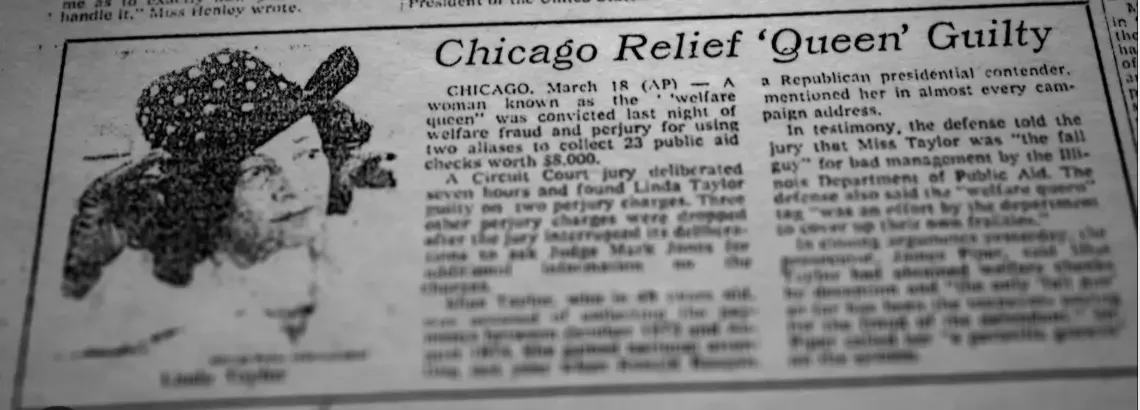
Linda Taylor’s case was reported on in the Chicago Tribune in the autumn of 1974.
1990s – Present - "Ob*sity Epidemic" Era
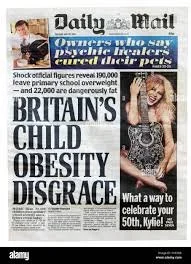
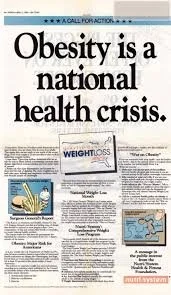
Fatness became framed as a major public health crisis through medicine, media, and government campaigns. “We are just concerned about your health” is a common retort. The “war on ob*sity” started in 2004 when the CDC released a report saying that 400,000 people died a year due to fatness. "It would soon lead to egregious and violent headlines across the nation about fat people, fat bodies, and the alarming rate at which they were allegedly dying from ob*sity. A year later, in January 2005, the CDC admitted that their 400K deaths number was a result of a “mathematical error,” and published another paper showing that fatness was actually protective and the number who died from it in a year was around 100K, not 400K.” - Da’Shuan L. Harrison
In 1998, against the advice of its own experts, new (and arbitrary) lower BMI thresholds from the National Institutes of Health classified millions more people as "ov*rweight" or "ob*se," accelerating concern about an "epidemic" despite no sudden change in population weight. Billions have been poured into efforts to study and fix this so-called “epidemic,” which then reinforces the belief that fat bodies are unhealthy and unnatural.






c. 2014 – Present - Continued Modern Police Brutality
The police murders of George Floyd, Mike Brown and many more exposed how modern policing continues the legacy of slave patrols. Police and media framed the victims' fatness as reasons for their murder, describing them as massive, superhuman, "Hulk Hogan", and "bulk[ing] up to run through the shots." - Da’Shaun L. Harrison
c. 2021 – Present - Ozempic Era
The widespread adoption of GLP-1 medications saw thinness presented as medically achievable and morally responsible. Fat bodies are further framed as problems to be solved.
Public discourse increasingly blurs the line between “it’s just about health” and pressure to conform to thin-supremacy. Fat Black bodies have worse health outcomes, which are blamed on fatness (and a “Black problem”) and not on hundreds of years of exploitation, inequality, and control of Black bodies.

Model walking in a Berlin Fashion Week show in 2024; the image accompanied a Vogue article.
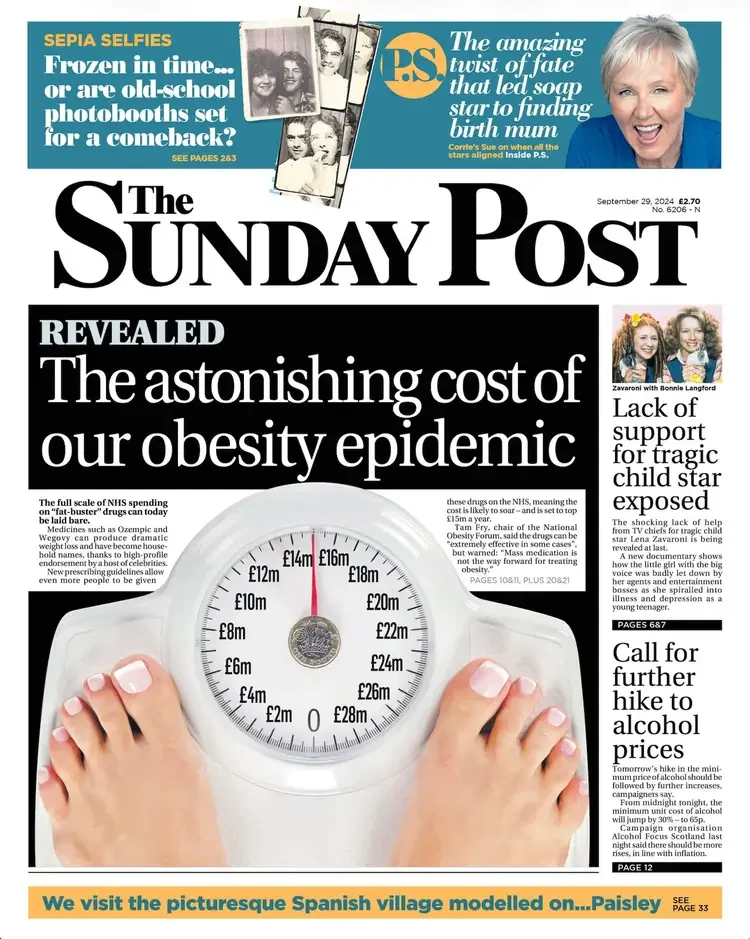
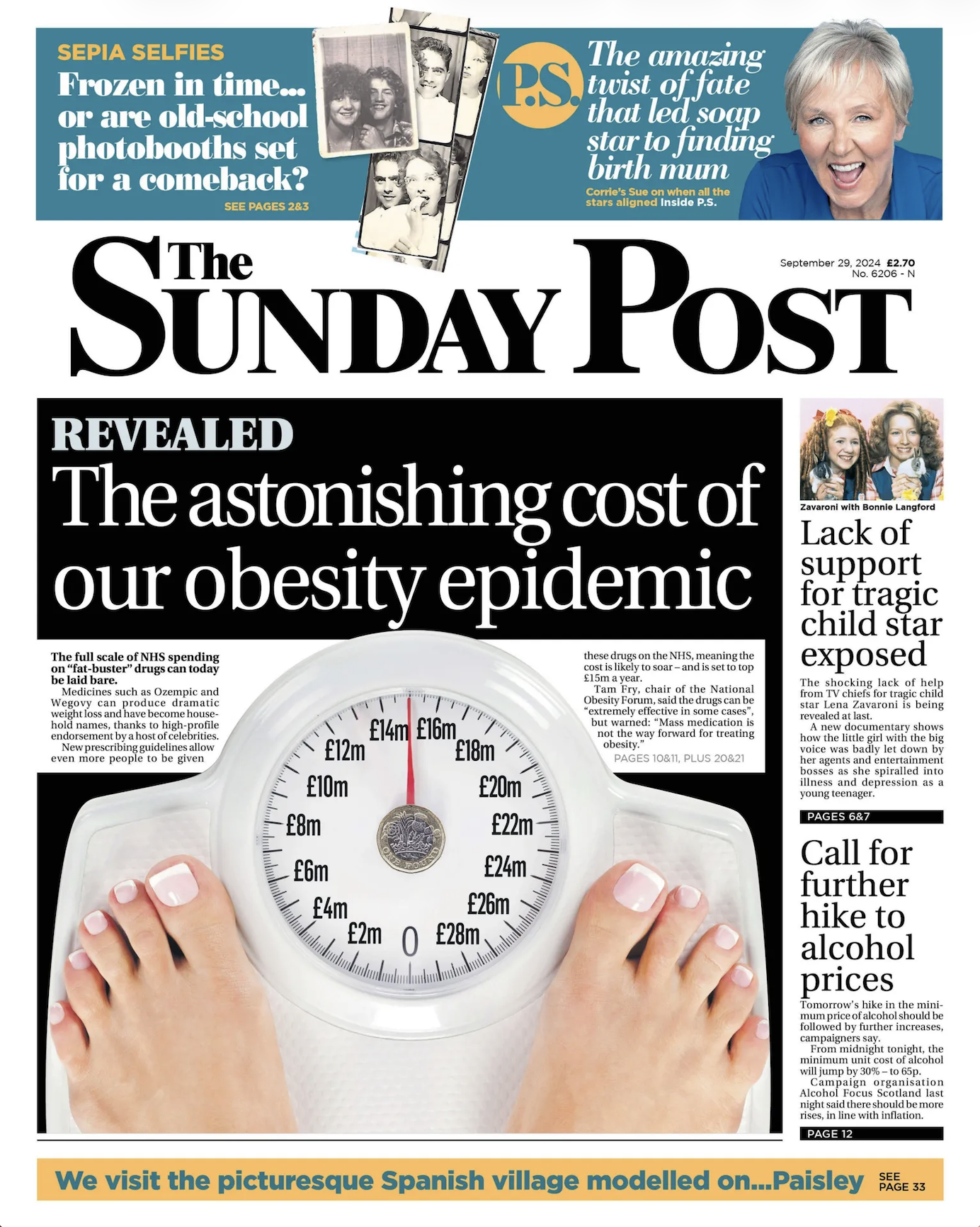
The sensationalist front page of The Sunday Post, a Scottish newspaper, September 2024, claims the costs of fatness are astonishing and a major health crisis.
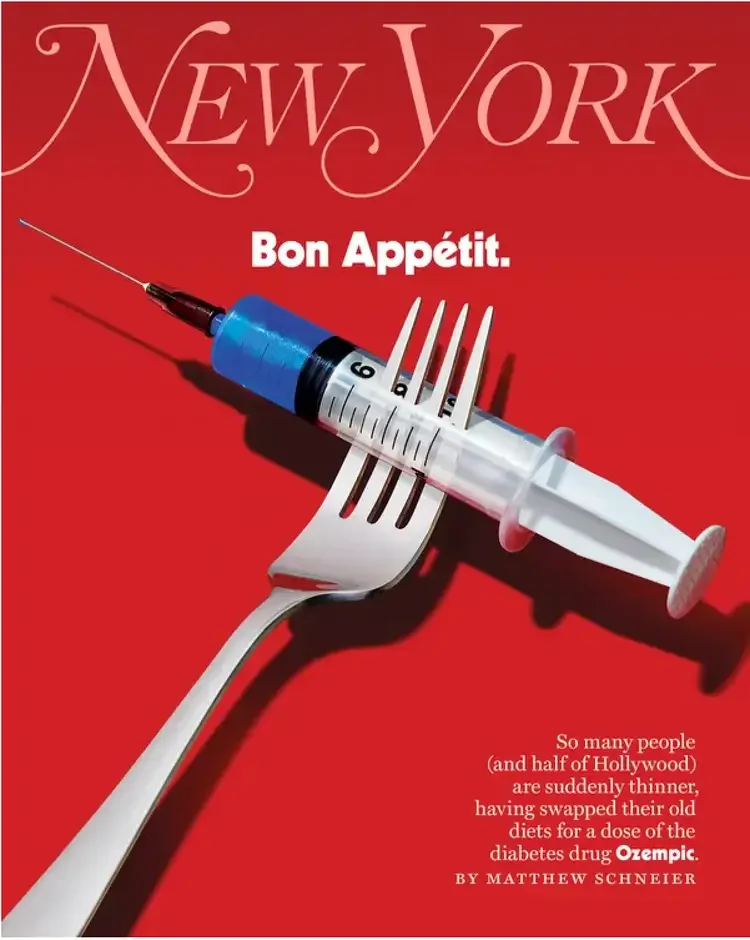
New York Magazine cover, Feb. 2023
Learning that modern anti-fatness has roots in anti-Blackness can be uncomfortable.
This history challenges narratives many of us have accepted as fact - “we all know that it’s unhealthy to be fat. It’s common knowledge, you can’t dispute the evidence!”
Realizing that there could be other factors to consider means we need to reflect on our beliefs about beauty, health, morality, and body size that may feel natural or obvious.
Not considering where our beliefs have originated from leaves us without important information, and most people would be sad to know that their desire for a thin body has inextricable roots in the oppression of Black bodies and continues to harm today.
Without the historical understanding of anti-fat bias, it’s easy to look at data that shows fat Black people can have worse health outcomes and claim it’s because fat Black bodies are just not as healthy as thin white bodies and not consider the centuries of oppression that absolutely have negative impacts on health. Despite what “we all know,” we don’t actually have data to show that adipose (fat) tissue causes poor health outcomes - only correlational data. We also know that bias, delayed and subpar healthcare, and yo-yo dieting (which is the natural outcome of dieting) are strongly correlated with poor health outcomes. Add to that the toll that racism, ableism, sexism, transphobia, homophobia, and more have on our bodies (and our access to healthcare). Yet, those realities are almost never considered when stigmatizing headlines about the epidemic of fatness are written.
If we want a world where all bodies are treated with dignity, we simply cannot afford to ignore the history of thin supremacy, because no matter your body size, we are all hurt by the fear of fat. So the next time you hear that voice in your head telling you that your body is too big, think about where that message came from, and maybe you’ll pause before internalizing words from those who were committed to destroying fat Black bodies for centuries.
About the Author:

Vinny Welsby (they/them) is a fat activist, diversity, equity and inclusion leader and founder of Fierce Fatty and Weight Inclusive Consulting. They have been a leading voice in dismantling anti-fat bias and diet culture for over a decade, a TEDx speaker, a podcast host, and a master's student in psychotherapy. Vinny is trans-non-binary and is dedicated to shifting how society views fat and queer bodies through education and compassion.
When Vinny isn’t talking about DEI stuff, they love snuggling with their dog, cross-stitching swear words and singing in a pop choir.
Follow Vinny on Instagram, Facebook or LinkedIn or get their free resources: the Body Image Recovery Handbook or How to Make Your Workplace Size Inclusive (or check out many other free resources here).
Sources:
Diet Culture Timeline. (n.d.). Retrieved June 10, 2026, from https://dietculturetimeline.com/
Drapetomania—2005—Question of the Month—Jim Crow Museum. (n.d.). Retrieved June 10, 2026, from https://jimcrowmuseum.ferris.edu/question/2005/november.htm
Harrison, D. (2021, April 28). “Belly of the Beast” Excerpt: The War on Drugs and The War on Obesity. Da’Shaun L. Harrison. https://dashaunharrison.com/belly-of-the-beast-excerpt-the-war-on-drugs-and-the-war-on-obesity/
Hartman, S. V., Taylor, K.-Y., Fuentes, M. J., & Haley, S. (2022). Scenes of subjection: Terror, slavery, and self-making in nineteenth-century America (Revised and updated paperback edition). W.W. Norton & Company.
Hill Collins, P. (2026). Black feminist thought. Routledge.
Hooks, B. (2001). Ain’t I a woman: Black women and feminism (Nachdr.). Pluto Press.
Owen, L. J. (2007). Consuming Bodies: Fatness, Sexuality, and the Protestant Ethic. https://escholarship.org/uc/item/4gw1m18r
Strings, S. (2019). Fearing the black body: The racial origins of fat phobia.
New York University Press.
Strings, S. (2020, May 25). Opinion | It’s Not Obesity. It’s Slavery. The New York Times. https://www.nytimes.com/2020/05/25/opinion/coronavirus-race-obesity.html
The Racist Origins of Fatphobia- BUST. (n.d.). The Racist Origins of Fatphobia. Retrieved June 11, 2026, from https://bust.com/feminism/196525-racist-origins-of-fatphobia.html
The significance of Sarah Baartman. (2016, January 7). BBC News. https://www.bbc.com/news/magazine-35240987
Wilson, J. P., Hugenberg, K., & Rule, N. O. (2017). Racial bias in judgments of physical size and formidability: From size to threat. Journal of Personality and Social Psychology, 113(1), 59–80. https://doi.org/10.1037/pspi0000092