

What Dieting Does to Your Mind and Body
TLDR: Food restriction can disrupt hormones, metabolism, hunger, immune function, and cardiovascular and bone health, while also causing food obsession, impaired concentration, mood changes, anxiety, and social withdrawal. Dieting isn't a neutral health behaviour, and its effects can vary depending on our bodies, identities, and life experiences. There are many alternatives to dieting, including HAES, intuitive eating, fat liberation and more.
Psst: Want to listen to this post as a podcast episode? I got you! Click here for episode 210 of The Fierce Fatty Podcast: What Dieting Does to Your Mind and Body
Have you ever thought, “Starting this new diet is going to make me healthier, thinner and more attractive! The upsides totally outweigh any small negatives.” I know I have, but that was before I came to know the sometimes devastating harm intentional weight loss can cause - to our minds and our bodies. Dieting isn't a benign or neutral intervention for many people, and in this post, I outline what actually happens in your body and brain when you start that “healthy” cleanse or “balanced” diet.
TW: mention of eating disorder behaviours, specific calories and self-harm.
A disclaimer:
Before we start, I want to note that everyone is different, and so we cannot predict how intentional weight loss affects an individual's body or how at risk they are to develop an eating disorder. Also, how much someone eats on a diet doesn’t indicate how much they will or will not be negatively affected. Just because you’re not doing a very low-calorie diet or sticking celery and dust up your bum doesn’t mean a diet is safe.
Plus, when we think about what diets do to us, we also have to think about intersectionality - so a person's background and their identity. What have their life experiences been? Do they experience stress due to marginalization? Are they food insecure? Are they disabled, neurodivergent, racialized, trans, etc.? All of those factors could increase the harm that dieting can have.

For example, as a child, I was food insecure and lived in a home where diet culture was present. We didn’t have enough to eat, and when we did, we were told not to eat too much, or we would get fat and fat is very bad indeed. This environment made me more susceptible to being preoccupied with food, even when I had access to food as an adult. Compounding that, due to my AuDHD and interoception issues (being connected to my body sensations like knowing I am hungry), it’s taken me so long to learn how to eat. Now, also add on the impact of anti-fatness, other marginalizations and life experiences, which means that I am likely at a higher risk of worse outcomes from dieting.
This was proven when my dieting turned into 2 separate eating disorders. I also want to note that my levels of privilege as a white person, someone who is university educated, from the UK/Ireland and more means that the impacts could’ve been lessened. This is not only because, due to my privilege, I don’t experience the violence of racism, for example, but also because it is easier for me to access care and care from people who look like me, should I need it.
So keep that in mind: everyone is different and has unique experiences and identities that can influence outcomes, so we cannot predict that everyone will be harmed, or harmed in the same way. The information and studies I will be citing below are from population studies - your outcomes can be the same, different or somewhere in between.
What Happens in Your Body When You Diet?
When you begin to eat less, your wonderful body does everything it can to support what it sees as a famine, starvation, or crisis. We are unable to tell our body that it needn’t worry; we are only dieting to fit into our wedding dress or starting a detox to feel healthier no need to panic! All our body knows is that it is not getting the nutrients it needs to survive, and it needs to triage so that we have a better chance of surviving this crisis. It will slow or shut down certain functions it sees as nonessential to life and do everything it can to help us find food and conserve energy. Every person’s body has unique energy needs, and we cannot predict that a “balanced” weight loss diet will mean we can trick our bodies into not triggering this response. If we eat less than we need to function, our wonderful bodies say, “I’m taking the wheel.” Specifically, this is what happens in our bodies:

To supply glucose to the brain, the body breaks down its own muscle and fat stores. It targets the muscle as it’s easier to break down; remember, muscles are not just biceps or glutes; your heart is also a muscle, and that’s kinda a big deal for the whole being alive thing. You may think it’s great to break down fat, but adipose (fat) tissue is one of the body’s most active and dynamic organs (as I discussed in 206: 49 Benefits of Being Fat). Adipose tissue produces hormones, communicates with organs, regulates temperature and immunity, cushions organs and joints, and supports metabolic functions
Reproductive hormones are suppressed, changes in menstruation, including periods stopping (side note: I find it particularly nonsensical that people are told to lose weight to conceive when intentional weight loss harms the ability to conceive. Make it make sense?!). Your libido and sexual function are reduced, as well as thyroid changes and potential organ dysfunction.
Your basal metabolic rate drops to conserve energy, lowering body temperature and resting heart rate.
Blood pressure rises, and your blood vessels can become damaged as your heart works harder to pump blood.
Your body also slows stomach emptying, called gastroparesis, which causes bloating, nausea, and severe constipation.
You become more likely to get infections as your body is in a weakened state from being flooded with cortisol (stress hormone). Cortisol's primary role is to prepare you for fight or flight with a potentially deadly adversary, not fight that flu you picked up last week at the potluck.
Weight cycling, also known as yo-yo dieting, which is the expected outcome of diets which have a 95% failure rate, triggers inflammation in the body. Inflammation is bad news and causes an increased risk of chronic diseases. It’s directly linked to an increased risk for specific forms of cancer (renal cell carcinoma, endometrial cancer, and non-Hodgkin's lymphoma), high blood pressure, insulin resistance that can make it harder for the body to regulate blood sugar, gallstone attacks, and changes in blood fats such as cholesterol and triglycerides, which lead to worse long-term cardiovascular health.
Higher risk of osteoporotic fractures and irreversible osteoporosis as bone density decreases. This is caused by lower sex hormones (remember the triage your body does) as well as increased cortisol levels. Interestingly, being fat is protective against osteoporosis, but the increased risk from dieting is not mitigated by having a bigger body.
Increase in POPs: Breaking down body fat can release persistent organic pollutants (POPs), which have been linked to chronic diseases such as type 2 diabetes and cardiovascular disease.
Restricting food is one of the strongest predictors of developing an eating disorder. And you don’t even have to diet yourself - living in a culture that encourages dieting also increases eating disorder risk.
Faster aging: That increased cortisol also triggers other chemical changes that damage cells in our body, which means that we age faster. When cells are damaged, they die quicker, and this is what aging is. This leads to declines in physical and cognitive function, like muscle weakness, decreased bone density, and slower organ and sensory responses.
Your hunger cues are disrupted because your body shifts from relying on internal biological cues to following external rules, which gradually dulls your natural appetite signals telling you when you’re hungry or full. Eventually, after screaming at you to eat for so long, your body will realize it’s not working and try other methods. Your interoceptive awareness (your ability to detect internal bodily sensations) weakens, and you become less connected to your body, which can take years to heal.
Increased death and illness: Weight cycling is the most common result of dieting, and weight cycling increases:
Morbidity (Rates of being sick or having a medical condition in a population)
Mortality risk (The likelihood that someone will die within a certain period) and
All-cause mortality (The number of people who die, regardless of what they die from).
What Happens in Your Mind
Hunger dominates your brain; you become preoccupied with food, often to the point of obsession, having constant thoughts, dreams, and fixations on food. You may talk about food more, look at recipes excessively and keep food at the forefront of your mind. Your brain does an incredible job here, ringing the alarm and forcing you to focus on food so that you focus on eating. Feeling obsessed with food, even to the point you’re sure you’re addicted to it, is a natural response from a starved brain. It doesn’t mean you’re greedy or out of control. This fixation can last LONG after stopping a diet, especially when we internally shame ourselves for this response after eating food.

Calorie restriction causes cognitive impairment: It reduces working memory (a cognitive function that allows you to temporarily hold and actively use a small amount of information, such as calculating a tip or remembering someone's name). Your reaction times are slowed, and your executive function is impaired. Executive function is like the air traffic controller of your brain, helping you juggle multiple tasks - like cooking dinner and listening to a podcast and then answering the door when someone knocks. Dieting will make you be less able to cope with life and its demands because you won’t have as much cognitive capacity as your brain has more important tasks to think about (like keeping you alive in this famine).
Hunger triggers severe mood swings, depression, apathy, low self-esteem and explosive irritability because you don’t have the resources or bandwidth to deal with more than the very basics. Plus, remember all that cortisol we spoke about? That is going to make you feel stressed out! Even if someone isn't experiencing dramatic starvation, they can still struggle immensely, as dieting can occupy an enormous amount of mental bandwidth because dieting is cognitive labour. An article called The Fog of Hunger discusses the cognitive cost of hunger, including how it can make people easier to dismiss. You’re less able to thrive and easier to control or manipulate. Dieting has been described as a political sedative because if you’re starving, you are less able to resist oppressive forces.
Your body will make you anxious and hypervigilant: Your body knows something bad is happening because you’re not eating enough; it’s not sure what, but it’ll keep you ready to fight that threat. That means you’ll be on edge; you’ll struggle to sleep or have disturbed sleep, and you may be jumpy. You can be in a state of hypervigilance and not even know what’s wrong aside from feeling tired or “off.”
You can withdraw socially as interest in socializing (especially around people who are not on a diet), hobbies, and intimacy decreases as energy is directed strictly toward survival. Your body wants you still. Plus, you don’t want to go out in case you’re tempted to eat food or drink alcohol, which could lower your inhibitions, leading you to listen to your body that’s begging to be fed. Once the diet draws its natural conclusion (it stops working and most people gain more weight than they lost due to no fault of their own), you could isolate yourself further due to shame.
The Minnesota Starvation Experiment:
In 1944, researchers wanted to understand how prolonged food restriction affects the body and mind, and how people recover from starvation, partly to help people experiencing famine after World War II. 36 men who were conscientious objectors volunteered to participate in the experiment. They were selected to ensure they were able to get along with others, were mentally robust and eager to assist. The young men started 3 months of normal eating for a baseline, then followed a starvation diet for 6 months, aiming to lose around 25% of their body weight, and finally ended with 3 months of refeeding.
(The following images are pages from the book Men and hunger: a psychological manual for relief workers, released in 1946.)
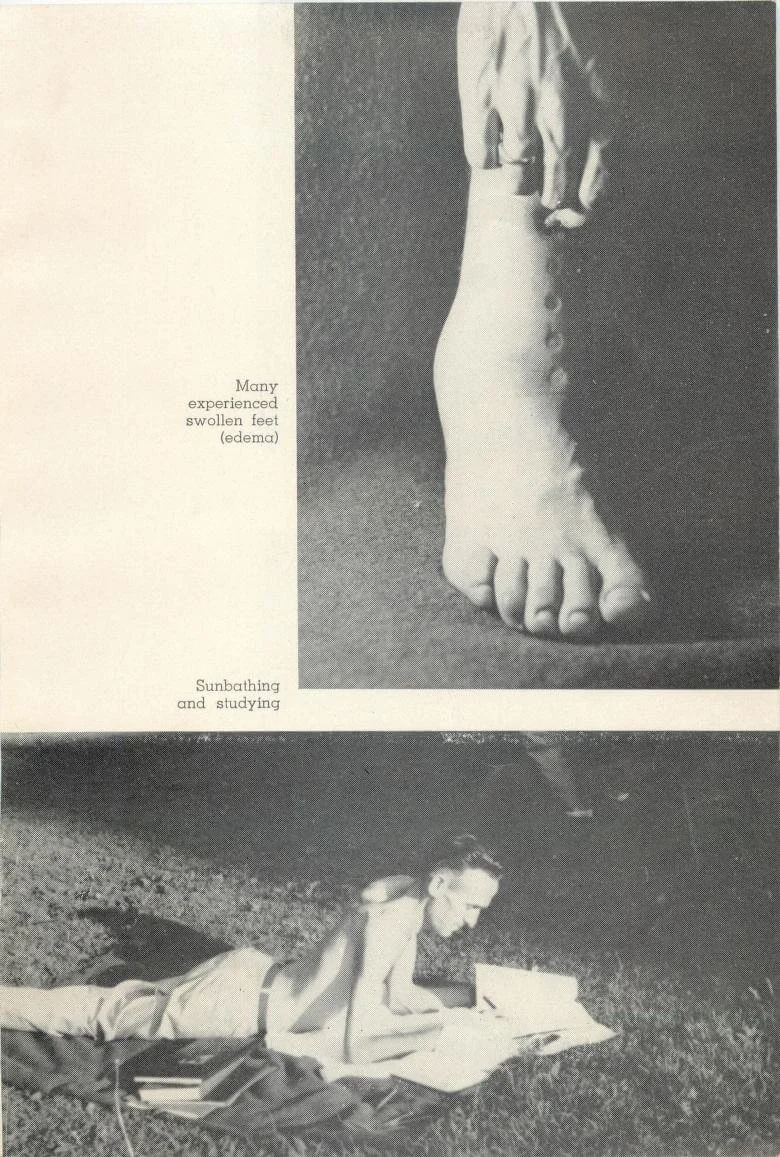
Baseline: 3,200 - 3,500 calories a day
Starvation diet: 1,800 calories a day, dropping to 1,570 for some men to meet their 25% weight loss target.
Refeeding: 2,200–3,600 calories a day and then 3,000–4,200 calories a day as the men were still losing weight. This stage was said to be the most psychologically difficult.
Additional refeeding: Some men stayed on after the experiment and were allowed to eat what they liked, which was between 5,000 - 11,200 calories a day.
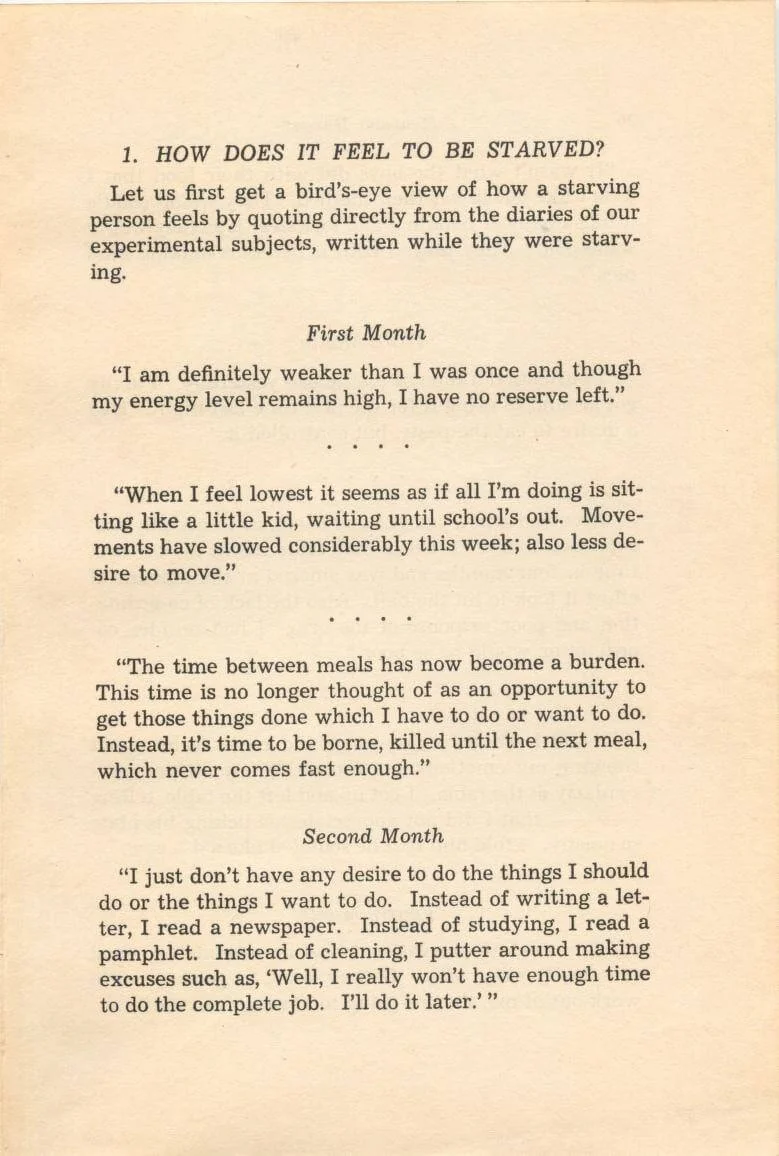
The psychological impacts:
Sam Legg: During the rehabilitation phase, he chopped off three fingers with an axe. He later said he was unsure whether he had done it deliberately, describing himself as “crazy mixed up.”
Franklin Watkins: His food obsession escalated into stealing food, dreams of cannibalism, threatening to kill himself and the researchers and other symptoms that led to psychiatric hospitalization. After a couple of days of normal food in the hospital, he was back to his normal self.
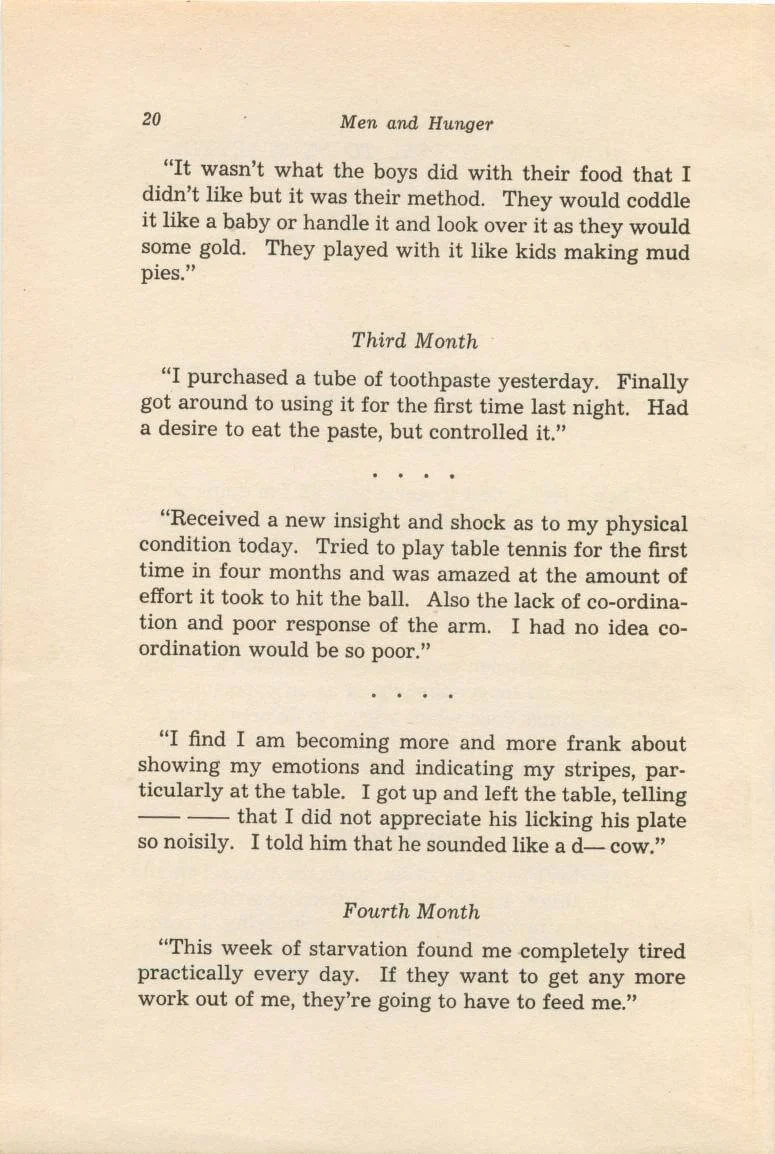
Other participants: Collected cookbooks, fantasized about eating, stole food, turned eating into lengthy, ritualized experiences including playing with their food and licking their plates. They lost interest in relationships, sex, and social activities, didn’t feel like laughing or enjoying anything. They experienced depression, emotional distress, and obsessive hunger that often continued even after food was reintroduced, which included searching trash for food and eating 40 packs of gum a day (which was later banned). Many became apathetic, withdrawn, irritable, and filled with rage at the other participants.
It took months and years for the men to recover and find peace with food after only 6 months on a diet of 1570 - 1800 calories a day, which many of us would view as moderate and not at all extreme.
Why do we keep dieting?

Many of us know that dieting isn’t effective, doesn’t feel great and causes us harm. But we are still dieting en masse. Why? Well, from my viewpoint, the question is more apt to be framed as “why would we stop dieting or pursuing thinness?” Yes, even after we know the harms, why would we stop when the desperation that so many people feel to be thin is intoxicating? I remember the feeling well; I would’ve done almost anything to have a smaller body. I didn’t care that it could harm my health; I would’ve gladly traded thinness for a multitude of negative health outcomes. That’s because
I truly believed being thinner was better in every way: it was healthier, I would be more attractive, I would be treated with more respect, and deep down I knew I would be loved and accepted more.
I would experience less anti-fat bias. I would be safer in a world that tells me fatness is abhorrent, grotesque, and abnormal. I could receive medical care that is evidence-based; I could access the world, ride on every rollercoaster I wanted, and buckle every airplane seat belt. I could walk into a clothing store and buy something there; I could feel safe that the person I was dating wasn’t doing charity work because of my great personality but disappointing body.
Giving up the hope of a smaller body by turning our backs on dieting is not something everyone can do. It can be very painful, and for some people it can be dangerous, especially if someone is multiply marginalized. Sometimes dieting means that a person is able to survive or gain access to things like gender affirmation surgery or IVF.
Whatever you do to survive this fucked up world is none of my business, and I am pleased if people have a way to cope that feels ok or good for them. But what if you do want to say goodbye to diets, but still want to be healthy and happy?
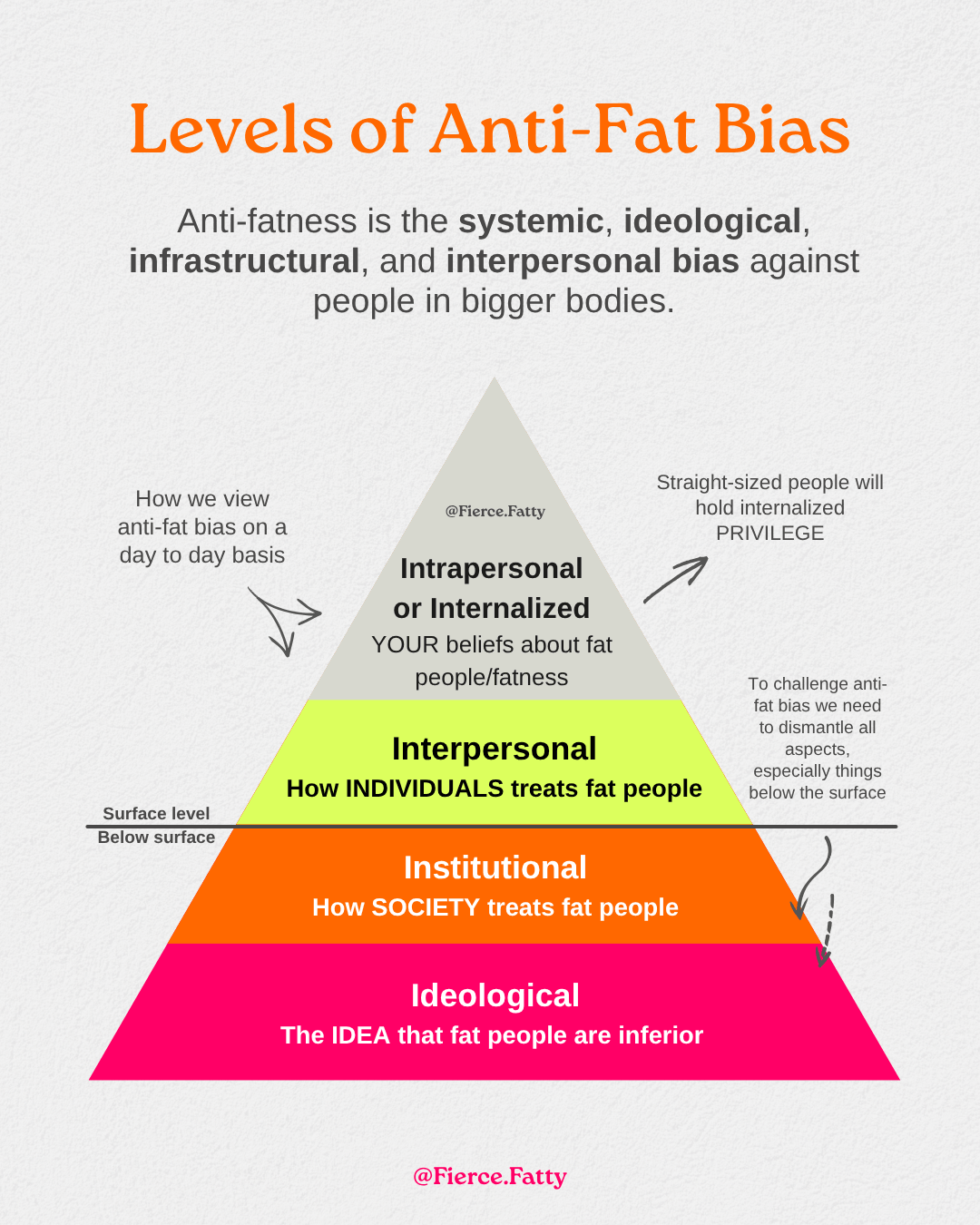
So what do we do if we don’t diet?
Weight, health, worth, and attractiveness are separate concepts. You can be fat and healthy, fat and attractive, and of course we are all worthy no matter our body size. But also, I want to point out that you don’t have to be fat and healthy to be worthy. Many people are unable to be healthy, no matter their body size, due to disability, chronic illness, genetics, their environment, discrimination and more. For some people, focusing on other aspects of life outside of health is their priority. All of it is ok and morally equal! Keep that in mind as we look at these options outside of dieting:
Health at Every Size: Focus on actual health markers (what does your bloodwork say, for example), and engage in sustainable health behaviours that improve health outcomes outside of weight loss. When we focus on health-promoting activities, we are more able to stick with them versus if we are tracking health according to our weight.
Consider all aspects of health and how to be healthier. What you eat and if you exercise is only a small portion of what makes up someone's health status. Have you considered that health also includes things like being connected to your community, wearing a seatbelt, having access to water or healthcare, or safer sex? Check out the determinants of health to learn more.
Intuitive eating: Reconnecting with internal hunger and fullness cues helps restore a peaceful relationship with food as well as unlearning harmful food rules. Intuitive eating may be harder for some folks, like neurodivergent people, as it means leaning into listening to internal cues, but it can still be helpful.
Fat liberation and social justice: Dismantling anti-fat bias protects people of all body sizes and teaches us to respect body diversity. Understanding the systems that taught us that fatness is bad is so helpful in shifting sticky beliefs we can carry with us about our bodies.
Self-compassion: Treating yourself with care disempowers harmful diet culture standards. This includes thanking your body for all the work it did and does for you (especially when you were ignoring its pleas during dieting!). We can be experts at being cruel to ourselves, and so unlearning shame can be incredibly powerful.
Keep Learning, Keep Unlearning
If this resonated with you, you're far from alone. Many of us are working to dismantle anti-fatness while also navigating the ways it shapes our own experiences, relationships with our bodies, and everyday lives.
Creating change requires both personal reflection and systemic action. Here are some ways to keep that work going:
Deepen your understanding: Download The Body Image Healing Guide: Surviving Anti-Fat Bias and Breaking Free from Body Shame for free, with tools and insights to help you explore anti-fat bias and body image.
Keep unlearning: Explore the Size Diversity Resource Guide, available for free when you join the lowest Ko-Fi tier.
Create change at work: Bring size inclusion into your workplace through training and consulting with Weight Inclusive Consulting.
Stay connected: Follow along on Instagram for ongoing education, practical tools, and honest conversations about dismantling anti-fatness.
You don't need to have all the answers, and you certainly don't need to do this work perfectly. Every step counts, including the messy ones.
You are worthy. You always were, and you always will be.
Stay fierce, fatty!
About the Author:

Vinny Welsby (they/them) is a fat activist, diversity, equity, and inclusion leader, and the founder of Fierce Fatty and Weight Inclusive Consulting. For more than a decade, they have worked to challenge anti-fat bias and diet culture through education, advocacy, and storytelling. Vinny is a TEDx speaker, podcast host, and master's student in psychotherapy, bringing together personal experience and professional learning to explore how we can create a more inclusive world for fat and queer bodies.
As a trans, non-binary person, Vinny is passionate about shifting societal attitudes through compassion, critical thinking, and meaningful change.
When they're not talking about DEI, you'll find Vinny snuggling with their dog, cross-stitching swear words, or singing in a queer pop choir.
You can follow Vinny on Instagram, Facebook, and LinkedIn. You can also explore their free resources, including the Body Image Recovery Handbook, How to Make Your Workplace Size Inclusive, and many more resources.
Sources Mentioned in the Podcast:
Bacon, L. (2010). Health at every size: The surprising truth about your weight (Rev. & updated). BenBella Books.
Bacon, L., & Aphramor, L. (2011). Weight Science: Evaluating the Evidence for a Paradigm Shift. Nutrition Journal, 10(1), 9. https://doi.org/10.1186/1475-2891-10-9
Berg, S. (n.d.). The Fog of Hunger: A hungry woman is easier to dismiss than a well-fed woman. Aeon. Retrieved September 15, 2026, from https://aeon.co/essays/a-hungry-woman-is-easier-to-dismiss-than-a-well-fed-woman
Brookshire, B. (2025). Fat Doesn’t Deserve Its Bad Rap. Scientific American. Retrieved September 15, 2026, from https://www.scientificamerican.com/article/fat-doesnt-deserve-its-bad-rap/
Brown, J. (Host). (2026). When Eating Less Backfires: What Your Body’s Really Doing to Protect You [Broadcast]. https://podcasts.apple.com/us/podcast/when-eating-less-backfires-what-your-bodys-really-doing/id1547179580?i=1000746686984
Chang, S. (2026). The Complexity of Eating Disorders in Trans & Non-binary Community. https://www.folxhealth.com/library/eating-disorders-tgnc
Drury, C. R., Beccia, A. L., Shaqour, S., Riddle, M., Gorrell, S., Singh, S., Duffy, A., Mehler, P. S., Zucker, K., Le Grange, D., Rienecke, R. D., & Reilly, E. E. (2026). Eating disorder severity and treatment outcome across race/ethnicity, sexual orientation, and socioeconomic status: Intersectional inequities in a clinical sample. Social Science & Medicine, 404, 119504. https://doi.org/10.1016/j.socscimed.2026.119504
Ferrucci, K. A., McPhillips, E., Lapane, K. L., Jesdale, B. M., & Dubé, C. E. (2023). Provider perceptions of barriers and facilitators to care in eating disorder treatment for transgender and gender diverse patients: A qualitative study. Journal of Eating Disorders, 11, 36. https://doi.org/10.1186/s40337-023-00760-9
Gaudiani, J. L. (2018). Sick Enough: A Guide to the Medical Complications of Eating Disorders (1st ed.). Routledge. https://doi.org/10.4324/9781351184731
Guetzkow, H. S. (1946). Men and hunger: A psychological manual for relief workers. Brethren Publishing House. http://archive.org/details/MenAndHunger
Gunawardana, S. C. (2014). Benefits of healthy adipose tissue in the treatment of diabetes. World Journal of Diabetes, 5(4), 420–430. https://doi.org/10.4239/wjd.v5.i4.420
Mann, T. (2015). Secrets from the eating lab: The science of weight loss, the myth of willpower, and why you should never diet again. HarperWave.
Miller, K. (2016). The Starvation Study You Need To Read. https://www.refinery29.com/en-us/minnesota-starvation-experiment
Norgan, N. G. (1997). The beneficial effects of body fat and adipose tissue in humans*. International Journal of Obesity, 21(9), 738–746. https://doi.org/10.1038/sj.ijo.0800473
Penwell, T. E., Bedard, S. P., Eyre, R., & Levinson, C. A. (2024). Eating Disorder Treatment Access in the United States: Perceived Inequities Among Treatment Seekers. Psychiatric Services, 75(10), 944–952. https://doi.org/10.1176/appi.ps.20230193
Persaud, A., Duncan, A. E., & Shields, M. C. (2026). Exploring Barriers Racial-Ethnic Minority Groups Face in Accessing Eating Disorder Treatment and Proposed Solutions. Psychiatric Services (Washington, D.C.), 77(3), 241–249. https://doi.org/10.1176/appi.ps.20250197
Sakers, A., Siqueira, M. K. D., Seale, P., & Villanueva, C. J. (2022). Adipose-tissue plasticity in health and disease. Cell, 185(3), 419–446. https://doi.org/10.1016/j.cell.2021.12.016
Tomiyama, A. J., Ahlstrom, B., & Mann, T. (2013). Long‐term Effects of Dieting: Is Weight Loss Related to Health? Social and Personality Psychology Compass, 7(12), 861–877. https://doi.org/10.1111/spc3.12076
Tylka, T. L., Annunziato, R. A., Burgard, D., Daníelsdóttir, S., Shuman, E., Davis, C., & Calogero, R. M. (2014). The Weight-Inclusive versus Weight-Normative Approach to Health: Evaluating the Evidence for Prioritizing Well-Being over Weight Loss. Journal of Obesity, 2014, 1–18. https://doi.org/10.1155/2014/983495