
How to Stop Hating Your Body
TLDR: Body shame and anti-fatness can stop us from living the lives we want. In this post, we'll explore what body expectations have cost us, what we want to reclaim, and how to take small, meaningful steps towards body confidence. Using exercises inspired by ACT, Narrative Therapy, and Compassion-Focused Therapy, you'll learn to set realistic goals, navigate fears, and build confidence at your own pace.
Psst: Want to listen to this post as a podcast episode? I got you! Click here for episode 212: How to Stop Hating Your Body
Ever been curious about what body shame has cost you? For many, the number of ways living in a society steeped in anti-fatness and diet culture has harmed them is numerous. I want us to be able to reclaim the things we lost from the clutches of anti-fatness and diet culture, and that’s what we are going to do in this post! Using exercises inspired by ACT, Narrative Therapy, Compassion-Focused Therapy, and behavioural approaches, we’ll explore your values, set realistic goals, navigate fear, and build confidence at your own pace. Let’s dive in!
TW: brief mention of eating disorder behaviours.
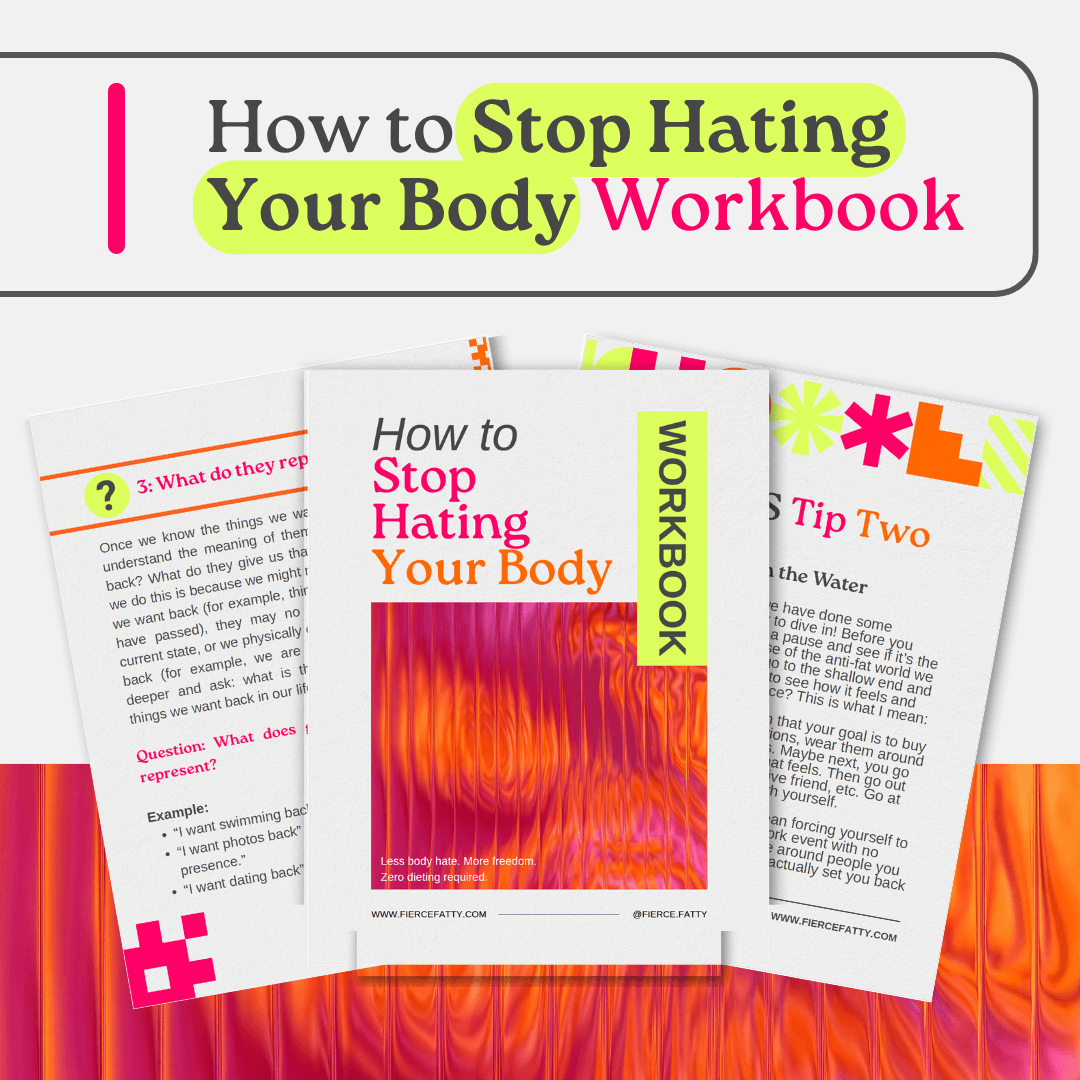
Get the Accompanying Workbook
This blog has a downloadable workbook so that you can complete the exercises. Download it here.
The exercises we are going to do draw quite a lot from Acceptance and Commitment Therapy (ACT), as well as Narrative Therapy, Compassion-Focused Therapy, and exposure/behavioural therapy.
Acceptance and Commitment Therapy (ACT): helps you acknowledge your relationship with your thoughts and feelings. You learn to understand your feelings instead of changing them.
Narrative Therapy: helps people become experts in their own lives by understanding and changing their personal stories that impact their self-view and interactions.
Compassion-Focused Therapy (CFT): designed to help people develop self-compassion, reduce harsh self-criticism, and heal from shame.
Exposure/behavioural therapy: Exposure therapy is a treatment within cognitive behavioural therapy (CBT) where a therapist helps you safely confront feared objects, activities, or situations to reduce avoidance and anxiety.
We will be doing some exercises in the this blog, and it’s important to only do things that feel good to you. If anything feels overwhelming, then please pause, stop or speak to a therapist.
I want to tell you a story.
It’s 1995, and we are in Fiji, in a region called Nadroga, which is a rural area. You’ve just finished school, and you’re running home, excited because you just got TV. Television was not introduced to the region until 1995. You’re a teenage girl, but you don’t think much about your body or what food you eat, and neither do your friends. It’s just not an issue. Traditional Fijian culture generally valued larger, more robust bodies and robust appetites, and eating disorders appeared to be extremely rare; in fact, there had been only one reported case of anorexia in Fiji by the mid-1990s. That is until TV arrived. American television characters became models for how you and your friends thought about your body and your value in the world.
Researchers surveyed adolescent girls shortly after TV arrived and then surveyed another group three years later, in 1998.
Shortly after television was introduced, 12.7% of adolescent girls showed high levels of disordered eating attitudes.
Three years later in 1998, after the girls had been exposed to television for even longer, that figure had risen to 29.2%, which is double the rate.
None of the girls in the 1995 group reported making themselves vomit to control their weight. By 1998, 11.3% reported doing this.
One girl reportedly said about the women she saw on television:
“I want their body. I want their size.”
We don't have a comparable study showing what that percentage is today, but later research in 2007 found that disordered eating was associated with peer pressure and changing social norms around eating, weight and body image.
What are your thoughts?
1: How would things be different?
Imagine you lived somewhere where bigger bodies were seen as normal and you and the people around you weren’t influenced by a culture that tells us our bodies are wrong.
How might your life have been different?
What things might you have done or not done?
That question phrased in different ways:
What have body expectations cost you?
What have worries or pressures about your body taken away from you?
What have concerns about your body caused you to miss out on?
Have thoughts or feelings about your body ever gotten in the way of living the life you want? How?
Examples:
I won’t let my partner touch my belly
I won’t wear things that show my arms
I make excuses about joining friends on a hike
I have a “uniform” of the same clothes I wear every day
I won’t go swimming anymore as I have put on “too much weight”
Spending time, money, and energy on changing your body
Dating - not dating, being with unkind people, accepting less
Clothes (Loss of self-expression, hiding yourself, trying to make yourself look smaller)
Joy (Being in shame, not going to events or dancing or hiding yourself)
Movement (Swimming, hiking, dancing - don’t want to be the slowest or out of breath)
Photos - creating memories with you being present
Connection with others - isolation
It’s really sad that you missed out on those things. IIt’s important to sit in the grief of what this bullshit has cost you. It’s not ok that you heard those messages and keep hearing them. You have done everything you can to survive in a world that tells you that no matter what you do, you have less value because your body is not this non-changing, static representation of the beauty ideal. The expectation is that we have the body of a prepubescent girl forever, and that’s just creepy and not how bodies work.
2: What do you want back?
If you had a magic wand and could wave it right now, of the things you listed in the previous question, what would you like back in your life today? Don’t think about the things you think you’re unable to do due to how you feel about yourself; just let your mind dream and connect with what you REALLY want outside of what others think.
Question: What do you want back?
What part of your life, identity, or humanity feels disconnected? If body struggles took up less space, what would you want more room for? Who were you before all these rules and pressures?
Examples:
Swimming
Being in photos
Dating
Going to the party
Wearing clothes you actually like
3: What do they represent?
Once we know the things we want back, it's important to understand the meaning of them. Why do we want them back? What do they give us that we long for? The reason we do this is because we might not be able to get the things we want back (for example, things that are time-based and have passed), they may no longer be relevant in their current state, or we physically cannot do the things we want back (for example, we are now disabled). So let’s dig deeper and ask: what is the FEELING underneath the things we want back in our life?
Question:
What does getting those things back represent?
Example:
“I want swimming back” → “I want playfulness.”
“I want photos back” → “I want memories and presence.”
“I want dating back” → “I want connection.”
4: Do you actually want to do those things?
Question: Do you want to work towards getting the things you listed?
Would it be helpful for you to have those things in your life? Are some of the things you do actually keeping you safe, so you shouldn’t change them? For example, you may wear the same type of clothes every day, which is great for you because you don’t have to make a decision every morning about what to wear, and you know you'll feel comfortable in them. OR it could be that you actually want to express yourself through clothes differently but feel anxious about switching things up.
If yes, you do want to work towards getting the things you listed: What is one tiny action that moves you 1% toward reclaiming that? We want to keep it small enough that your nervous system doesn’t revolt, as doing new things can be scary. Let’s take the things you want to change and make them into goals. Don’t overwhelm yourself with too many goals, and don’t pick things that could be harmful to your mental health or that you feel unsafe doing.
Examples:
wear shorts at home
be in one photo
sit poolside
buy a comfortable outfit
say yes to a social event
5: Make some goals
Now let’s make it into a proper goal. A mistake I see people make is saying, “I just want to feel better about my body,” without understanding what that actually means for them. If you don’t know what that means for you, how can you work towards it? For example, if you don’t wear sleeveless tops but want to, you could make it into a SMART goal like this:
Specific: I will wear a sleeveless top
Measurable: I will wear it in my bedroom for 5 minutes
Attainable: I can afford to buy a new sleeveless top online, and I have access to it in my size
Relevant: Hiding my arms is annoying, as I get really hot and just want to be free
Time-bound: I will do this by (date in the nearish future). Tip: Break longer-term goals into smaller, more achievable goals for quicker wins
Bonus tips:
Tip 1: Get Out of Constant Learner Mode
A mistake folks make when trying to improve their confidence is only focusing on learning how to be confident. Listening to podcasts, reading books, following people.
All these things are great and can be super powerful! However, it could be like trying to learn how to swim by reading a book on swimming techniques. At some point, you have to get in the pool and try!
Actually practicing DOING confident things is crucial if you ever want to learn “how to swim.”
BUT wait! Before you do, don’t make this mistake…
Tip 2: Tinkle Your Toes in the Water
So we know our goal(s), we have done some learning, and we are ready to dive in! Before you jump in the deep end, take a pause and see if it’s the safest thing for you. Because of the anti-fat world we live in, would it be wiser to go to the shallow end and tinkle your toes in the water to see how it feels and build confidence and resilience? This is what I mean:
Tinkling your toes could mean that your goal is to buy a couple of sleeveless top options, wear them around the house and see how it feels. Maybe next, you go outside quickly and see how that feels. Then go out and spend time with a fat-positive friend, etc. Go at your own pace and check in with yourself.
Diving in the deep end could mean forcing yourself to wear a sleeveless top to a big work event with no cover-up when you’re going to be around people you know are judgmental. This could actually set you back and harm your confidence!
Tip 3: Identify Barriers and Mitigate Them
What things in your life contribute to making you feel bad about your body? What things make you feel good?
For example, your Mum always talks about weight, and it’s really triggering for you. With this info, you can decide to Remove, Reduce or Protect, like this:
Remove: I will remove this thing/person from my life. (E.g. I’ll stop watching the Love Island TV show, which only has thin/normative bodies).
Reduce: I will expose myself less to the triggering thing/person. (E.g. I’ll set a boundary when Mum talks about diet or cut the convo short).
Protect: I am exposed to the trigger that I can’t remove or reduce, and so I will support my mental health in the best ways that are available to me. (E.g. When I see a diet advert, I will go listen to my fave fat-positive podcast).
These might not be possible/practical/appropriate for many reasons, but they are options that could be available to you.
Tip 4: Be gentle with yourself
This stuff takes time. It’s like learning a new language when you’ve spoken only one your whole life. People who speak 2 or more languages mention how they think in their original language or have to actively translate to the new language before speaking. It’s a cognitive challenge, and unlearning anti-fatness and diet culture is the same; we are changing the way our brain thinks. Plus, we are still in the same society that speaks that old language. The more you expose yourself to the new language, the easier it becomes, so make sure you follow awesome fat people on social media, read books, listen to podcasts, or go to events if possible.
What’s next?
I hope this blog is instrumental in helping you identify what is important to you and take the steps towards it! Remember to take it slow, so you don’t overwhelm yourself, but challenge yourself where you’re able.
If you’d like more, then check out The Body Image Recovery Handbook, a free body image workbook designed to help you improve body image, build body confidence, and heal from anti-fat bias and diet culture. If you constantly criticize your body, worry about being judged because of your size, or feel stuck in cycles of shame, this guide offers practical, evidence-informed tools to help you break free.
Inside, you'll learn how anti-fat bias affects body image, identify signs of internalized anti-fatness, understand why body shame develops, and discover strategies to protect your mental well-being while building a more compassionate relationship with your body. Whether you're beginning your body image healing journey or looking to deepen your understanding of fat liberation, this guide will help you move toward greater self-acceptance and lasting body confidence.
Wherever you are right now, know this: you're not alone, and you deserve to take up space exactly as you are. Remember, you are worthy; you always were and always will be.
Stay fierce, fatty!
Vinny (they/them)
About the Author:

Vinny Welsby (they/them) is a fat activist, diversity, equity and inclusion leader, and the founder of Fierce Fatty and Weight Inclusive Consulting. For more than a decade, they have worked to challenge anti-fat bias and diet culture through education, advocacy, and storytelling. Vinny is a TEDx speaker, podcast host, and master's student in psychotherapy, bringing together personal experience and professional learning to explore how we can create a more inclusive world for fat and queer bodies.
As a trans, non-binary person, Vinny is passionate about shifting societal attitudes through compassion, critical thinking, and meaningful change.
When they're not talking about DEI, you'll find Vinny snuggling with their dog, cross-stitching swear words, or singing in a queer pop choir.
You can follow Vinny on Instagram, Facebook, and LinkedIn. You can also explore their free resources, including the Body Image Recovery Handbook, How to Make Your Workplace Size Inclusive, and many more resources.
Source Mentioned in the Podcast:
Becker AE, Burwell RA, Gilman SE, Herzog DB, Hamburg P. Eating behaviours and attitudes following prolonged exposure to television among ethnic Fijian adolescent girls. Br J Psychiatry. 2002 Jun;180:509-14. doi: 10.1192/bjp.180.6.509. PMID: 12042229. https://pubmed.ncbi.nlm.nih.gov/12042229/