
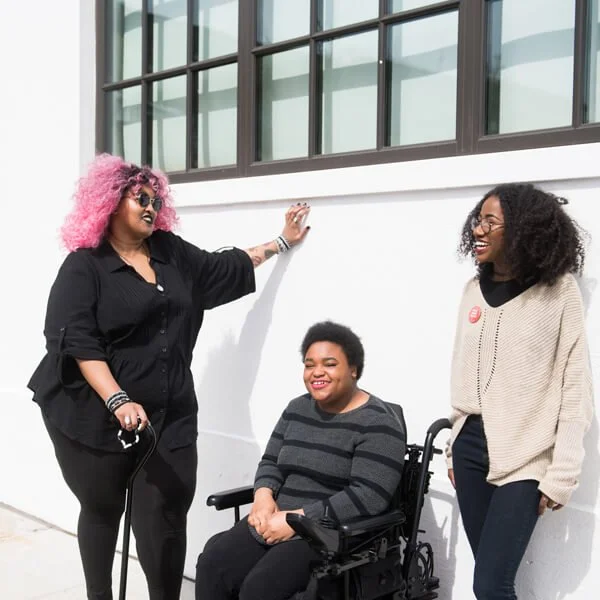
The Good Fatty vs Bad Fatty False Dichotomy is a harmful stereotyping of fat people as good or bad depending on a number of factors. Often, “good fat” people have increased privilege in society, as they are seen as more palatable, while " bad fatties " are the opposite.
Want to learn more about The Good Fatty vs Bad Fatty False Dichotomy? Check out the Fierce Fatty Podcast episode 103: What is a “Good Fatty” and “Bad Fatty”?
When someone doesn’t fit into the "bad fatty" archetypes, then that is given as a reason why they deserve abuse, lack of healthcare, bigotry, etc. Often GFBF behaviours are unintentional or include unearned privileges. It doesn't mean that you’re doing something wrong or right if you engage in one thing or another.
Understanding how we perceive fat people can help us unlearn anti-fat bias and examine our other biases.
What is the "good fatty" stereotype?
A "good fatty" is more acceptable to society and oftentimes is a safer role to inhabit as a fat person. Frequently pitied, encouraged, and celebrated for the weight they've lost or the journey they're on to lose weight. Good fatties are seen as more productive members of society and excellent tools for capitalism. Seen as morally superior to "bad fat" people. Can be looked down upon by others for still investing in diet culture and anti-fatness.
Diets. Is actively trying to lose weight
Eats "healthy" food in public or eats small amounts of food
Works out, can be an athlete and able-bodied
Is fashion-forward and adheres to gender norms
The 1st to make jokes about their body size, the "funny fat friend"
Is outwardly anti-fat and dislikes fat bodies, especially their own
Says “I’m fat, but I’m healthy!”
Has a “reason” for being fat that is seemingly "not their fault”
Hourglass shaped
What is the "bad fatty" stereotype?
A “bad fatty" is way less acceptable to society and is often an unsafe role to inhabit as a fat person.
Met with anger, disgust, disdain, and ridicule by many. Bad fatties are seen as less productive members of society and therefore less valuable. Judged as morally inferior. Celebrated by others for being “brave.”
Eats food perceived as “unhealthy,” potentially in public and on social media
Wears clothes that have been deemed “unflattering” and show their body
Likes being fat and celebrates size diversity
Is not trying to lose weight
Doesn’t discuss an “acceptable reason” for being fat
Disabled, unhealthy (and often marginalized in other ways, for example being racialized)
Doesn’t adhere to gender norms of femininity or masculinity in appearance
Doesn’t talk about their health status as a reason why they have more/less value
Can be perceived as “lazy”. Understands that capitalism and hustle culture is harmful to many and so doesn’t boast about how hard they work/how busy they are (to prove their importance) and instead values down time and self care
Won’t talk shit about other fat peoples (or anyones!) bodies
Not an hourglass shape or burly/butch - fat stomach, small breasts, flat bum. For masc people - short, softer - i.e. being perceived as having “feminine” traits. (Side note: no traits are inherently feminine or masculine)
Doesn’t brag about how much they exercise or exercises for reasons outside of appearance/manipulating body size and shape - for example to have fun
Is a “trouble maker” because they ask for equality and access regardless of their size. For example asking for evidence based healthcare at the doctors office or a seatbelt extender on a plane
It’s absolutely ok to do or be any of the items on the lists intentionally or unintentionally. Neither makes you better or worse. The GFBF dichotomy is made of stereotypes. No one fat person's experience is the same.
Where it becomes problematic is when we use the "good fatty" trope as a reason to discriminate against people who don’t adhere to it.
In understanding the good fatty, bad fatty dichotomy, we also need to examine the factors that other systems of oppression play. Racism, transphobia, ageism, ableism, healthism, colonialism and sexism, to name a few.
The reality is that all fat people deserve basic human respect, equal access, and acceptance no matter what.
Yes even if they are very fat. Even if they are “unhealthy”. Even if they are “lazy.” Even if you think they eat too much food. Even if they are a complete dickhead and not someone we like.
Fatness NEVER makes someone unworthy of respect and access to the world.
Want to learn more about The Good Fatty vs Bad Fatty False Dichotomy? Check out the Fierce Fatty Podcast episode 103: What is a “Good Fatty” and “Bad Fatty”?
Sources:
Kate Harding, Stacy Bias, Ragen Chastain, Kitty Stryker
Further reading Gemma Gibson (2021) Health(ism) at every size: The duties of the “good fatty”, Fat Studies, DOI: 10.1080/21604851.2021.1906526
About the Author:

Vinny Welsby (they/them) is a fat activist, diversity, equity and inclusion leader and founder of Fierce Fatty and Weight Inclusive Consulting. They have been a leading voice in dismantling anti-fat bias and diet culture for over a decade, a TEDx speaker, a podcast host, and a master's student in psychotherapy. Vinny is trans-non-binary and is dedicated to shifting how society views fat and queer bodies through education and compassion.
When Vinny isn’t talking about DEI stuff, they love snuggling with their dog, cross-stitching swear words and singing in a pop choir.
Follow Vinny on Instagram, Facebook or LinkedIn or get their free resources the Body Image Recovery Handbook or How to Make Your Workplace Size Inclusive (or check out many other free resources here).